




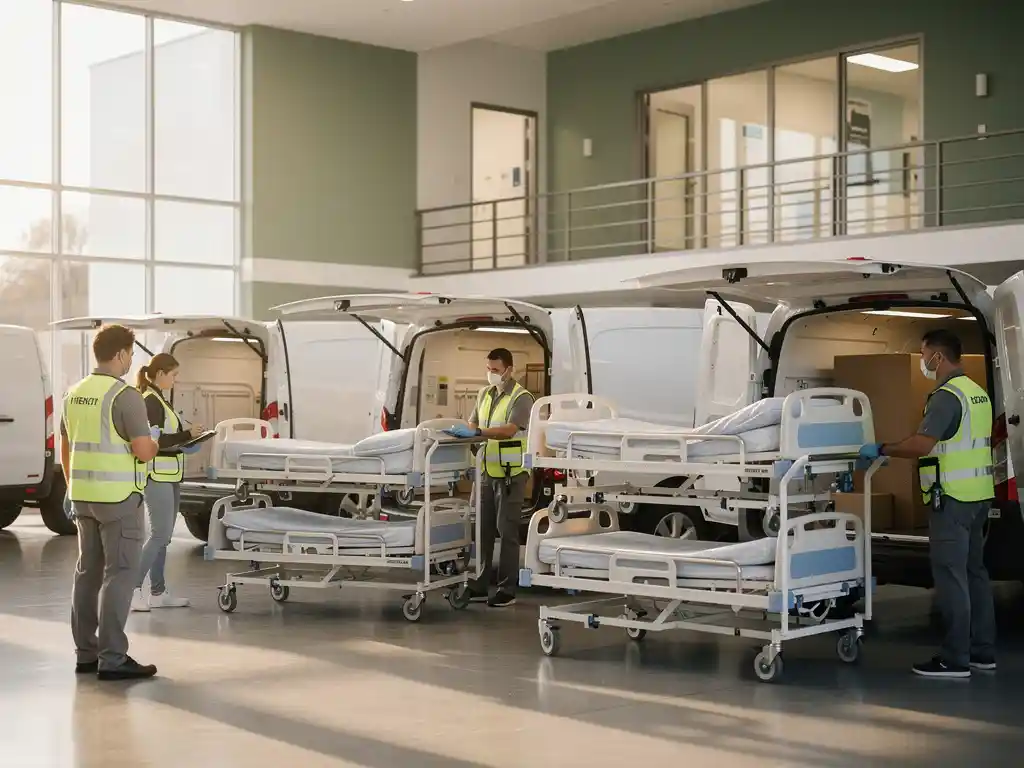
Fitting out a new care facility wing in under a week sounds like an impossible task. In reality, it is entirely achievable when every element of the process is planned in advance, suppliers are aligned to a single timeline, and the team on the ground knows exactly what to do and when. The difference between a smooth handover and a chaotic final day almost always comes down to logistics planning, not the work itself.
This guide walks you through each stage of a one-week fit-out logistics operation for a healthcare environment, from the first site visit to the moment you hand over the keys. Whether you are managing a new ward, a rehabilitation unit, or a residential care extension, the steps below give you a practical framework to follow.
Map the site and confirm logistics requirements first
Before any furniture is ordered or any delivery is booked, you need a complete picture of the physical environment. A care facility presents specific access challenges that a standard commercial fit-out does not: restricted corridors, infection control zones, lift weight limits, and the presence of vulnerable residents nearby. Missing any of these details early will cost you far more time later.
- Walk every access route from the loading bay to each room in the new wing, noting corridor widths, door frame dimensions, and any level changes or ramps.
- Confirm lift capacity, booking procedures, and any time restrictions on goods movement within the building.
- Identify which areas are live clinical zones and establish clear boundaries for logistics activity.
- Record all findings in a site logistics brief, including floor plans marked with delivery routes and staging areas.
- Confirm who the on-site contact is for the facility and agree a daily check-in process for the duration of the fit-out week.
After this step, you should have a documented site logistics brief that every supplier, installer, and driver can reference. If anything about the site is unclear at this point, resolve it now. Ambiguity on site access is one of the most common causes of delay during the fit-out window itself.
Coordinate suppliers and deliveries into a single timeline
A one-week fit-out window leaves no room for uncoordinated deliveries. If three suppliers arrive on the same morning without a shared schedule, you will quickly run out of staging space, block access routes, and lose hours to confusion. The goal here is a single master delivery schedule that every party has agreed to and committed to in writing.
- List every item that needs to be delivered, including furniture, medical equipment fixtures, soft furnishings, and any pre-assembled units.
- Assign each delivery a specific date, time slot, and access point based on your site map.
- Sequence deliveries so that larger items and room-defining pieces arrive first, followed by smaller items and finishing elements.
- Share the master schedule with all suppliers at least five working days before the fit-out window opens and request written confirmation from each.
- Build in buffer slots of at least 30 minutes between deliveries at the same access point.
With your delivery schedule confirmed, you have the backbone of the entire operation. Any supplier who cannot commit to their slot needs to be escalated immediately, not on the morning of their delivery. Our project logistics approach is built around exactly this kind of pre-coordinated scheduling, ensuring all parties work from one shared plan rather than separate arrangements.
Stage and pre-assemble items before the fit-out window opens
One of the most effective ways to compress the on-site installation timeline is to move as much work as possible off-site. Pre-assembly in a warehouse environment is faster, safer, and easier to quality-check than assembly in a live building. For a care facility fit-out, this step can save a full day of on-site time.
- Identify all items that can be fully or partially assembled before delivery, such as bed frames, storage units, and seating.
- Group items by room or zone so that each delivery load corresponds directly to a specific area of the wing.
- Label every item clearly with its destination room number and installation sequence.
- Conduct a quality check at the warehouse before anything is loaded, confirming that all components are present and undamaged.
Effective use of warehousing at this stage transforms the on-site window from a construction exercise into a placement and connection exercise. When items arrive pre-assembled, labelled, and grouped by zone, your installation team can move through the wing at a much faster pace. Verify before the fit-out week begins that every item in the warehouse matches the delivery schedule and that nothing is missing.
Execute on-site installation in a zone-by-zone sequence
With deliveries arriving on schedule and items pre-assembled, the on-site installation phase becomes a matter of disciplined sequencing. Working zone by zone, rather than room by room in a scattered order, keeps teams focused, reduces cross-traffic, and makes it easier to track progress against your timeline.
- Divide the wing into logical zones, typically by corridor section or functional area such as resident rooms, communal spaces, and staff areas.
- Assign a dedicated installation team to each zone with a clear list of tasks and a completion target for each day.
- Begin with the zone furthest from the main access point and work back toward the entrance, so completed areas are not disturbed by ongoing deliveries.
- Hold a brief team check-in at the start and end of each day to review progress, flag any issues, and adjust the next day’s priorities if needed.
At the end of each day, walk through the completed zones and confirm that installation matches the room specifications. Do not wait until the final day to discover that a bed frame was placed in the wrong room or that a storage unit is missing a component. Daily verification keeps small problems from becoming handover-day crises.
Handle last-minute changes without derailing the schedule
Even the most carefully planned fit-out will encounter unexpected changes. A supplier delivers the wrong configuration, a room specification is updated by the client, or an access route becomes temporarily unavailable. The key is having a response process ready before any of these situations arise, so the team can act quickly without losing momentum.
- Designate a single decision-maker on site who has the authority to approve changes without needing to escalate every issue.
- Keep a small buffer stock of commonly needed items, such as fixings, spare components, and standard furniture pieces, in the staging area.
- Maintain a live issues log that is updated throughout the day, so all team members know what has changed and what the agreed resolution is.
- If a delivery is delayed or incorrect, immediately assess the impact on the zone sequence and reorder tasks to keep other areas progressing.
The ability to adapt quickly is what separates experienced project logistics teams from those who are managing a fit-out for the first time. Flexibility does not mean improvising without a plan. It means having contingency options thought through in advance, so that when something changes, the response is fast and deliberate rather than reactive and disorganised.
Verify completion and hand over the space on time
The final step is a structured completion check that confirms every room in the wing meets the agreed specification before the facility team takes possession. A rushed or informal handover risks leaving problems that are far more disruptive to fix once the wing is operational.
- Use the original room specifications and furniture schedules as your checklist, verifying each item room by room.
- Check that all furniture is correctly positioned, fully assembled, and free from damage.
- Confirm that all packaging and waste has been removed from the wing and disposed of appropriately, particularly important in a healthcare environment.
- Walk through the completed wing with the facility’s designated representative and sign off each zone together.
- Provide the client with a handover document that records what was installed, any agreed snagging items, and the timeline for resolving them.
A clean, documented handover is the mark of a logistics operation that was managed well from start to finish. It protects everyone involved and gives the care facility team the confidence to begin using the wing without delay. If you are planning a complex healthcare fit-out and want to understand how structured project logistics can support your timeline, we are happy to talk through the specifics of your project.