


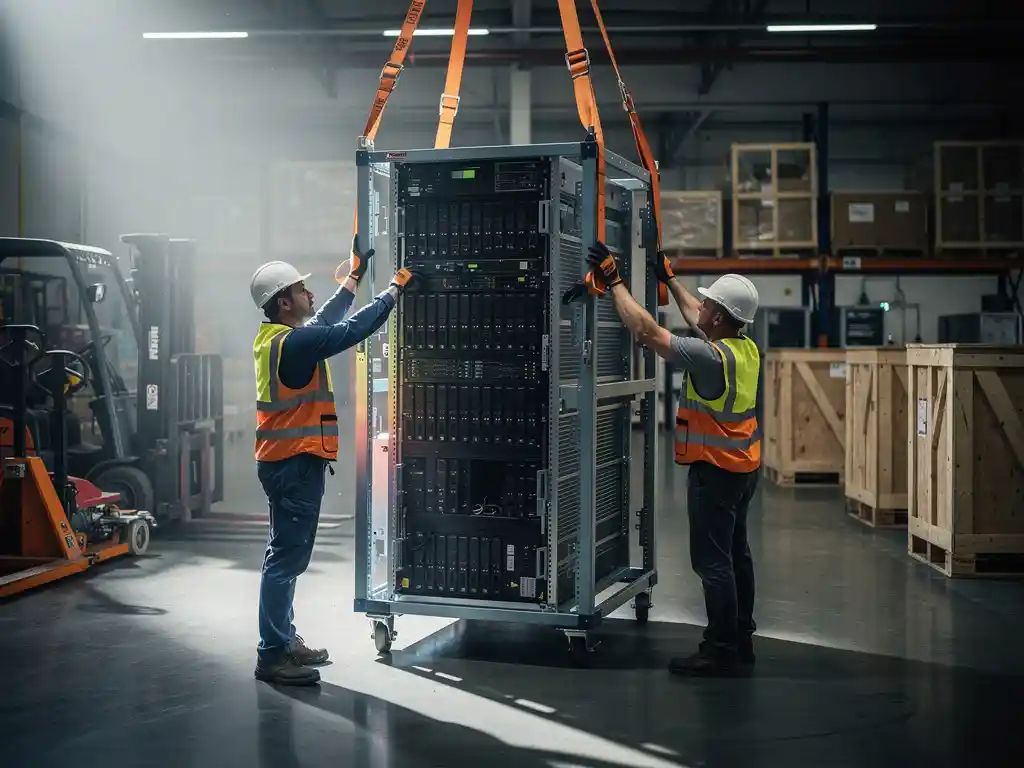
Safely relocating critical infrastructure requires meticulous planning, specialist handling, and a logistics partner with the technical expertise to manage every phase from origin to final installation. The stakes are high: delays, damage, or compliance failures can disrupt entire operations. This article walks through the key questions you need answered before undertaking any critical infrastructure move.
What makes critical infrastructure so difficult to relocate?
Critical infrastructure is difficult to relocate because it combines physical fragility with operational dependency. These assets are often large, heavy, and sensitive to vibration or environmental conditions, and any downtime during the move can cascade into serious business disruption. The difficulty compounds when moves cross borders, involve multiple parties, or require reinstallation in a live environment.
Unlike standard cargo, critical infrastructure often has no tolerance for delays. A server cabinet that goes offline for an unplanned extra 48 hours, for example, can affect thousands of end users. The same applies to medical equipment, industrial machinery, or telecommunications hardware. The relocation must therefore be treated not just as a transport exercise but as a full operational project with defined milestones, contingency plans, and clear accountability at every step.
Physical handling adds another layer of complexity. Many critical assets are precision-engineered and require specific loading techniques, custom packaging, climate-controlled environments, or vibration dampening during transit. Standard freight handling simply does not meet these requirements. This is why safely relocating critical infrastructure demands specialist knowledge that goes well beyond general haulage.
What types of infrastructure qualify as ‘critical’ in logistics terms?
In logistics terms, critical infrastructure refers to any asset whose relocation failure would cause significant operational, financial, or safety consequences for the organization that depends on it. This includes IT and server hardware, medical and laboratory equipment, industrial production machinery, telecommunications systems, and high-value interior fit-outs for sectors such as finance, healthcare, and technology.
The definition is broader than many assume. Consider a large-scale office fit-out for a financial institution: the coordinated delivery and installation of hundreds of workstations, server cabinets, and specialized furniture across multiple floors is a critical logistics operation. A delay in one component can halt the entire project. Similarly, furnishing a coworking space across international locations, as we do for clients in cities such as Berlin, Cape Town, and Paris, involves assets that are critical to the client’s ability to open and operate on schedule.
High-tech equipment deserves particular attention. We assemble server cabinets in a dedicated dust-free clean-room environment within our warehouse, because even minor contamination during handling can render sensitive hardware unusable. This level of specialist infrastructure is what separates a critical logistics operation from everyday cargo movement.
How do you plan a safe critical infrastructure relocation?
Planning a safe critical infrastructure relocation starts with a detailed site survey, a risk assessment, and the formation of a dedicated project team before any physical movement begins. Every phase, from packaging and loading through transport routing and final installation, must be mapped in advance with agreed timelines, responsible parties, and clear escalation procedures for unexpected events.
Effective planning for these moves typically follows a structured sequence:
- Asset audit: Catalogue every item to be moved, including dimensions, weight, fragility, and any special handling requirements.
- Site assessment: Evaluate both origin and destination for access constraints, elevator capacity, floor load limits, and installation requirements.
- Risk mapping: Identify potential failure points, including transit risks, customs delays for cross-border moves, and installation dependencies.
- Team assembly: Build a dedicated project team with the right mix of transport, installation, and coordination expertise.
- Timeline and contingency planning: Set realistic milestones and define fallback procedures for each critical phase.
- Execution and monitoring: Manage the move in real time with a single point of accountability overseeing all parties.
Just-in-time management principles are especially valuable here. Coordinating routes, lead times, and delivery windows to minimize idle time at the destination reduces both cost and risk. Our project logistics team applies this methodology across every complex relocation we manage, ensuring that no detail goes untracked from start to final handover.
What role does warehousing play in infrastructure moves?
Warehousing plays a central role in critical infrastructure relocations by providing a controlled staging environment where assets can be received, inspected, pre-assembled, and held securely before final delivery. Without this intermediate step, timing pressures at the destination site often force rushed handling, which increases the risk of damage or installation errors.
A well-equipped warehouse allows logistics teams to add real value before the asset ever reaches its final location. For complex IT infrastructure, for example, server cabinets can be partially assembled and tested in a controlled clean-room setting, reducing the time and risk associated with on-site work. For large-scale office or hotel fit-outs, goods from multiple international suppliers can be consolidated, inspected, and organized by installation sequence, so that delivery to the site is coordinated rather than chaotic.
Inventory management within the warehouse also provides a buffer against supply chain disruptions. If one component is delayed, the broader move does not have to stop. Our warehousing solutions offer more than 60,000 square meters of capacity, giving clients the flexibility to stage complex moves at their own pace without sacrificing control or security.
Who is responsible for customs and compliance during cross-border infrastructure relocation?
During a cross-border critical infrastructure relocation, the logistics partner is responsible for managing customs documentation, classification, and clearance procedures, but the client retains legal responsibility for the accuracy of the information provided. In practice, the most effective arrangement is one where a single logistics partner handles the entire administrative process on the client’s behalf, acting as the expert intermediary with customs authorities.
Cross-border moves introduce compliance requirements that vary significantly by country and asset type. High-tech equipment, medical devices, and certain industrial machinery may be subject to import licenses, end-use declarations, or temporary admission procedures. Missing or incorrect documentation at the border can cause delays that are particularly damaging for time-sensitive infrastructure moves.
We manage the complete customs and administrative process for our clients, removing both the logistical and administrative burden. This includes advising on the correct customs procedures for each asset type, preparing the necessary documentation, and coordinating with authorities at each border crossing. For clients moving infrastructure across multiple European or international locations, having a single partner manage this end to end is far more reliable than coordinating separate customs agents in each country.
How do you choose the right logistics partner for critical infrastructure moves?
The right logistics partner for critical infrastructure moves is one that combines specialist handling expertise, a proven project management methodology, in-house warehousing capability, and the ability to manage customs and compliance across all relevant jurisdictions. Credentials and track record matter more than price when the cost of failure is operational downtime or irreplaceable asset damage.
When evaluating potential partners, focus on the following criteria:
- Specialist experience: Has the partner handled similar asset types and project scales before? Ask for concrete examples, not general capability statements.
- Dedicated project management: Does the partner assign a named project manager who oversees every phase, or does accountability shift between departments?
- Own infrastructure: Partners with their own fleet, warehousing, and clean-room facilities maintain quality control that subcontracted networks cannot guarantee.
- International reach: For cross-border moves, the partner must have established relationships and compliance knowledge in every country involved.
- Single point of contact: One dedicated contact managing all communication eliminates the coordination gaps that cause delays in complex moves.
- Standards and certifications: Look for ISO certifications and documented quality standards as evidence of consistent operational discipline.
We have been operating as a full-service logistics partner since 1924, with a team of more than 200 logistics professionals and a global partner network built over decades. Our approach treats every complex relocation as a unique project, building a dedicated team around the specific needs and goals of each client. If you are planning a critical infrastructure move and want to discuss the right approach, get in touch with our team to explore how we can support you.