


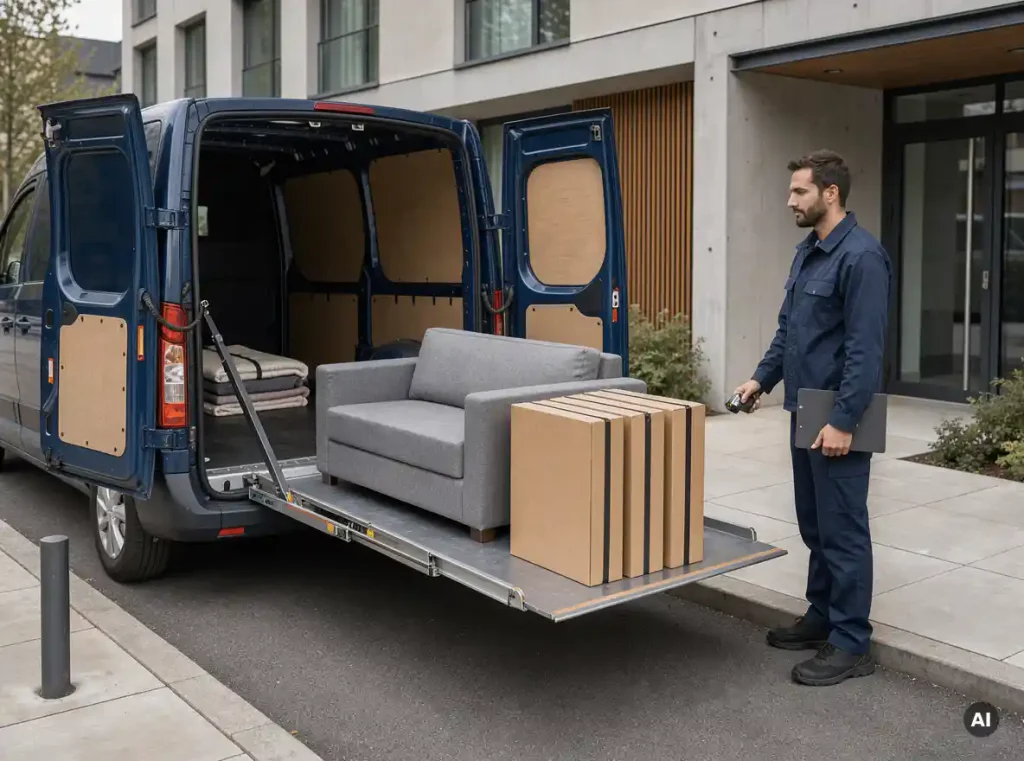
To schedule furniture delivery with one service lift, book the lift for a fixed time window, split the delivery into timed slots based on how long each drop needs, and add a buffer between slots. Treat the lift as the bottleneck, not the truck. Agree the plan with the building manager, the delivery team and the end customer before delivery day.
That approach works for a single apartment move, a hotel floor or a full office fit-out, because the lift sets the pace for everything else. We plan this kind of high-rise furniture delivery every week, and the questions below cover the points that matter most.
How Much Lift Time Does Each Delivery Need?
Most furniture deliveries need between 20 and 45 minutes of lift time per drop, depending on the number of items, the floor and how far the unloading point is from the lift. Heavy, bulky or fragile pieces take longer, and so does protective packaging that has to be removed on the way.
These numbers are planning estimates, not fixed rules. To build your own figure, consider these factors:
- Item count and size: A sofa and two chairs travel in one or two lift trips. A full dining set or a wardrobe system may need many more.
- Floor level: The higher the floor, the longer each round trip takes, especially when the lift also serves residents.
- Distance from lift to door: Long corridors slow down every trip, even when the ride itself is quick.
- Handling method: Pieces that arrive wrapped in furniture blankets are quicker to move than items in multiple layers of packaging.
- Assembly needs: If pieces are assembled on the floor, the lift is only needed for the carrying, not for the whole job.
A practical method is to count lift trips rather than minutes. Estimate how many trips the load needs, multiply by the round trip time on your floor, then add a margin. This gives a far more realistic slot than guessing a flat hour.
How Do You Build a Delivery Schedule Around One Lift?
Build the schedule by treating the lift as a shared resource: reserve one continuous booking window, divide it into consecutive slots per delivery, and sequence the slots so heavy or high-floor drops go first. Never overlap two deliveries on the same lift unless the building rules explicitly allow it.
Follow these steps to turn that into a workable plan:
- List every delivery with its address, floor, item count and any access limits.
- Estimate lift time per drop using the trip count method described above.
- Choose the booking window that fits the building’s rules, often outside peak resident hours.
- Sequence the drops from the highest floor down, or from the biggest load to the smallest, so the lift is clear of bulky pieces early.
- Assign time slots with a fixed start and end, and share them with every party involved.
- Confirm 24 to 48 hours ahead so changes can still be absorbed.
Clear delivery time slots also protect the people receiving the furniture. A customer who knows their slot is 10:30 to 11:15 can prepare the space, move cars and be present at the right moment. For complex multi-drop jobs, our project logistics team builds these slot plans as part of the overall delivery programme.
Who Needs to Be Involved in Lift Reservations?
Four parties usually need to be involved: the building manager or concierge who controls the goods lift booking, the delivery company, the person receiving the furniture, and any on-site contractor or installer. Without all four aligned, a booked slot can still fail on the day.
Each party has a different job in the process:
- Building manager: Confirms the lift availability, protection requirements for walls and floors, and any restrictions on timing or weight.
- Delivery company: Provides the estimated duration, crew size and arrival time, and flags any special handling needs in advance.
- Recipient: Confirms access to the unit, clears the delivery path and is reachable during the slot.
- Installer or contractor: Aligns assembly work with the lift schedule so carrying and installation do not collide.
One practical tip is to name a single point of contact for all communication. When we handle a delivery, one dedicated contact person coordinates between the building, the crew and the customer, so nobody has to chase three different people for an update. It keeps changes quick and prevents the classic situation where the lift is reserved, but nobody told the driver about the booking number or entrance.
What Buffer Should You Plan for Unexpected Delays?
Plan a buffer of roughly 15 to 30 minutes per delivery, or around 20 percent on top of the estimated lift time, whichever is larger. The buffer absorbs slow lifts, late access, parking problems and items that need extra care. Add more for older buildings and higher floors.
Typical sources of delay include:
- The lift being used by residents or other contractors during your window
- Waiting for the recipient or key holder to open the door
- Protective padding that must be fitted in the lift before the first item goes in
- Items that do not fit as expected and need a different route or angle
- Traffic or loading bay access issues at the building entrance
Place the buffer between slots, not only at the end of the day. A delay in the first drop then does not ripple through every following delivery. It also helps to schedule the most time-critical or fragile deliveries early, when the day is still on plan. If a slot runs short, the next customer gets a call right away rather than a surprise.
When Is a Single Lift Not Enough for the Project?
A single lift is not enough when the total lift time needed exceeds the hours the building allows, when many units on different floors need furniture in the same short period, or when the building cannot give you an exclusive window. At that point, the fix is to extend the timeline or add capacity.
Warning signs that one lift is a bottleneck:
- The calculated lift time for all drops is longer than the booking window available
- Several floors need furnishing at the same time, for example in a hotel or office opening
- The lift is shared with residents, so exclusive use is not possible
- Delivery has to meet a hard opening or move-in deadline
In those cases, there are several ways to stay on schedule. You can spread deliveries over more days, request a second lift or temporary external hoist, stage furniture in a nearby warehouse and release it floor by floor, or use assembly on site so that bulky items travel in flat or partly packed form. Staging is especially helpful for large fit-outs because the lift is only used when each floor is ready, not when the truck happens to arrive.
If you are planning a high-rise furniture delivery with many drops, get in touch with us early. The sooner we see the building, the lift rules and the delivery list, the easier it is to build a schedule that holds up on the day.