




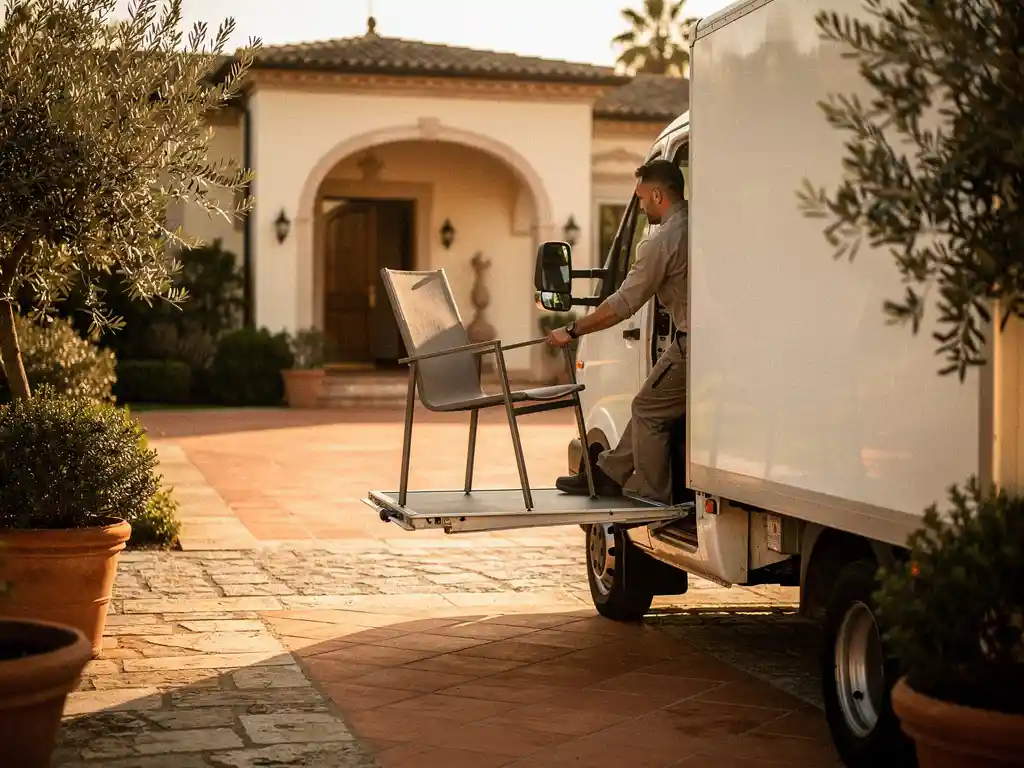
Italian designer garden furniture sits at the intersection of craftsmanship and complexity. Pieces made from teak, powder-coated aluminium, or hand-woven synthetic rattan are not just expensive — they are heavy, oversized, and often fragile in ways that standard parcel carriers are completely unprepared to handle. Getting them from the warehouse to the end customer’s terrace without damage, delay, or frustration requires a deliberate last mile logistics strategy, not a standard shipping label.
This guide walks you through every stage of that process: from defining your delivery requirements to resolving the failures that derail even well-planned garden furniture delivery operations. Follow these steps in order and you will have a repeatable, professional last mile delivery setup that protects both the product and the customer relationship.
Map your delivery requirements before choosing a partner
Before you contact a single carrier, you need a clear picture of what your shipments actually demand. Italian designer garden furniture varies enormously — a set of aluminium sun loungers presents very different logistics challenges than a modular outdoor sofa with a ceramic dining table. Map your requirements at the product level, not the order level.
- List every SKU or product category you ship and record its dimensions, weight, and packaging footprint.
- Identify which items require two-person delivery due to weight or awkward form factors.
- Note which products include assembly on delivery (for example, parasol bases, modular seating systems).
- Document the typical end-customer profile: private residential, hospitality, or commercial outdoor space.
- Define your service level expectations — standard kerbside, room of choice, white-glove with placement and debris removal.
Once this map exists, you have a specification document rather than a vague brief. Carriers and logistics partners can price accurately, and you can compare proposals on a like-for-like basis. Without this step, you will routinely receive quotes that do not cover what you actually need.
Select a last-mile carrier suited to premium garden furniture
Standard parcel networks are built for boxes under 30 kilograms. Luxury furniture transport requires something fundamentally different: two-person crews, lift-gate vehicles, route planning that accounts for residential access, and handlers who understand that a €3,000 dining table cannot be leaned against a wall at an angle. Selecting the wrong carrier at this stage is the single most expensive mistake in furniture last mile logistics.
Evaluate potential partners against the following criteria:
- Vehicle type: Do they operate curtainsiders or box trucks with tail lifts suitable for large garden furniture pieces?
- Crew capability: Are two-person delivery teams standard, or an add-on that needs to be requested?
- Coverage area: Does their network reach the postcodes your customers actually live in, including rural and coastal areas where garden properties are common?
- Track record with premium goods: Can they demonstrate experience handling high-value, oversized items without damage claims?
- Technology: Do they offer real-time tracking, proof of delivery with photos, and electronic signature capture?
Specialist furniture transport services are worth prioritising over general freight carriers, even if the per-shipment rate appears higher. The damage rate differential and customer complaint reduction will justify the cost quickly. Verify that any shortlisted partner carries adequate cargo insurance for the declared value of your products.
Set up packaging and handling protocols for safe delivery
Even the best carrier cannot protect a poorly packaged piece of Italian designer garden furniture. Packaging for last mile delivery differs from export or B2B packaging because the parcel will be handled multiple times by people who are not warehouse specialists, loaded and unloaded in residential environments, and sometimes left outdoors briefly before the customer can bring it inside.
- Use double-wall corrugated cardboard as a minimum for flat-pack components; add foam corner protection for legs and frame edges.
- Wrap upholstered outdoor cushions in sealed polythene to protect against moisture during transit.
- Secure glass or ceramic tabletop elements individually with foam sheeting and mark all four sides with fragile orientation indicators.
- Label every carton with the order number, the number of cartons in the set (for example, “3 of 4”), and the product description.
- Include a packing slip inside the outermost carton listing every component, so the customer can verify completeness at delivery.
After packaging, create a brief handling instruction card for your carrier’s crew. This does not need to be elaborate — a single laminated sheet showing which items are fragile, which require two-person lifting, and which cannot be stacked is enough. Verify that your carrier has actually briefed their teams on these protocols before the first delivery goes out.
Coordinate the delivery appointment and end-customer communication
With your carrier selected and your packaging protocols in place, the next step is building the communication flow that keeps the end customer informed and ready. Failed first delivery attempts are one of the most costly failures in garden furniture delivery — the item returns to the depot, a re-delivery is scheduled, and the customer’s confidence in your brand drops sharply.
- Send an order confirmation email immediately after purchase that includes an estimated delivery window and a contact number for delivery queries.
- Trigger an automated notification 48 hours before the scheduled delivery date, confirming the date and asking the customer to confirm access requirements (gate codes, parking instructions, preferred placement location).
- Send a day-of notification with a narrower delivery window — ideally a two-hour slot — so the customer can plan their day.
- Provide a direct contact method for the delivery crew, either via SMS or a carrier tracking link, so the customer can communicate in real time if needed.
Confirm that access to the delivery location is genuinely possible for your vehicle type. A large garden furniture set arriving by curtainsider truck at a property with a narrow lane or low bridge will cause an immediate failure. Collect this information proactively during checkout or in the pre-delivery communication, not on the day.
Handle assembly, placement, and debris removal on-site
For premium Italian designer garden furniture, delivery to the door is rarely the end of the service. Customers purchasing at this level expect the furniture to arrive assembled, positioned correctly, and ready to use. This is where last mile delivery becomes a white-glove service, and where the quality of your logistics partner’s on-site crew makes a direct impression on your brand.
Assembly on-site
Brief your delivery crew on the specific assembly requirements of each product range. Modular outdoor sofas, parasol systems with weighted bases, and dining sets with glass inserts all have different assembly sequences. Provide laminated quick-reference assembly guides that crews can use on-site without needing to access a phone or laptop.
- Confirm at the point of carrier briefing which products require on-site assembly and estimate the time required per unit.
- Ensure crews carry the correct tools — typically Allen keys, rubber mallets, and gloves — as standard kit.
- Have the crew complete a final quality check after assembly: all fixings tight, upholstery seated correctly, glass or ceramic tops level and secure.
Placement and debris removal
Placement means positioning the furniture where the customer wants it, not where it is easiest to leave it. Ask the customer to confirm placement preferences during the pre-delivery communication so the crew arrives with a clear plan. Once placed, all packaging materials — cardboard, polythene, foam inserts — must be removed from the property. Leaving debris is a common complaint in furniture last mile operations and one that is entirely avoidable.
We handle this end-to-end through our project logistics capability, which covers full installation of furniture and related items on-site, including debris removal, for both residential and commercial clients across more than 150 locations worldwide.
Resolve common last-mile failures for oversized furniture
Even well-planned garden furniture delivery operations encounter failures. The difference between a professional logistics setup and an amateur one is not the absence of problems — it is the speed and competence of the response. The following are the failures that occur most frequently with oversized, high-value garden furniture and how to resolve them.
Access failure at the delivery address
The vehicle cannot reach the property due to road width, height restrictions, or parking limitations. Resolve this by maintaining a list of alternative vehicle options with your carrier — a smaller van that can shuttle items from a nearby parking point is often the fastest fix. Build this contingency into your carrier agreement before it is needed, not during an active failure.
Damage discovered at delivery
If the customer or crew identifies damage on arrival, the crew should photograph the damage immediately alongside the packaging, note it on the proof of delivery record, and contact your customer service team before leaving the site. Do not ask the customer to contact you separately — own the resolution process from the moment damage is identified.
Incomplete shipment
A carton is missing from a multi-piece set. The crew should verify the count against the packing slip, confirm with the depot whether the missing carton is in transit, and give the customer a written confirmation of the missing item and the resolution timeline before leaving. Never leave a customer with incomplete furniture and no written commitment.
Customer not available
If the customer is not present despite confirmation, the crew should attempt contact via phone immediately. If contact fails, leave a calling card with a direct number and return the items to the depot with a priority re-delivery flag. Review your pre-delivery communication sequence to identify where the confirmation step failed.
Resolving these failures quickly and professionally is what separates a one-time transaction from a repeat customer. If you are looking for a logistics partner with the experience to handle premium furniture delivery at this level, get in touch with our team to discuss what a tailored last mile solution looks like for your product range.