


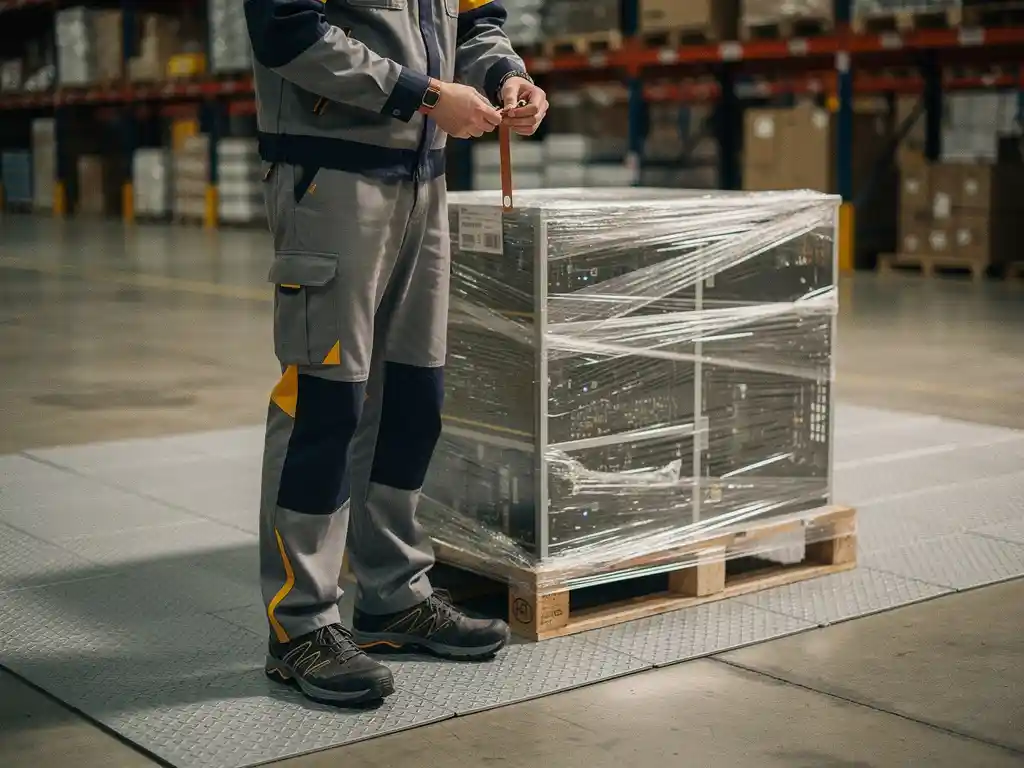
Static electricity during equipment transport is prevented through a combination of antistatic packaging, proper grounding, humidity control, and ESD-safe handling procedures. These measures work together to stop electrostatic discharge (ESD) from damaging sensitive electronic components before they ever reach their destination. The sections below break down each layer of protection and what it takes to move equipment safely.
What types of equipment are most vulnerable to static electricity during transport?
Electronic components and assemblies are the most vulnerable to static electricity during transport. This includes microprocessors, circuit boards, RAM modules, hard drives, server components, and any device containing semiconductors. Even a discharge of just a few hundred volts, completely imperceptible to a human handler, can permanently damage or degrade these components without leaving any visible sign of harm.
Beyond consumer electronics, industrial and medical equipment carries significant ESD risk. Programmable logic controllers (PLCs), sensor arrays, imaging equipment, and laboratory instruments all contain circuitry that is sensitive to electrostatic discharge. In many cases, the damage is latent, meaning the component continues to function after transport but fails prematurely in the field, making it especially difficult to trace back to a handling incident.
Server cabinets and IT infrastructure deserve particular mention. These assemblies combine multiple sensitive components in a single unit, and a single ESD event during loading or unloading can affect several boards at once. For logistics providers handling complex project installations involving IT infrastructure, the stakes are high and the margin for error is essentially zero.
What causes static electricity to build up during equipment transport?
Static electricity builds up during equipment transport primarily through triboelectric charging, which occurs when two materials come into contact and then separate. When packaging materials, conveyor belts, foam padding, or even a handler’s clothing rub against equipment surfaces, electrons transfer between materials, leaving one surface positively charged and the other negatively charged. The charge accumulates until it finds a path to discharge.
Several transport-specific factors accelerate this buildup:
- Movement and vibration: Constant motion inside a vehicle causes equipment to shift against packaging materials, repeatedly generating and accumulating charge.
- Low humidity environments: Dry air inside truck trailers or aircraft cargo holds dramatically reduces the air’s ability to dissipate charge naturally, allowing it to accumulate faster.
- Synthetic materials: Plastic wrapping, foam inserts, and synthetic textiles are among the most effective charge generators, which is why standard packaging materials can actually worsen ESD risk if they are not antistatic.
- Handler movement: A person walking across a carpet or synthetic floor mat can accumulate thousands of volts of charge, which transfers instantly upon touching unprotected equipment.
Understanding these causes is the foundation for selecting the right protective measures. Each risk factor points directly to a countermeasure, whether that is material selection, environmental control, or procedural discipline during loading and unloading.
What antistatic packaging materials are used to protect equipment during transport?
Antistatic packaging materials used to protect equipment during transport include antistatic bags, conductive foam, ESD-safe bubble wrap, and shielding bags. These materials are specifically engineered to prevent charge buildup and to shield contents from external electrostatic fields. The choice of material depends on the sensitivity of the component and the conditions it will encounter during transit.
Antistatic and static-shielding bags
Pink antistatic poly bags are the most common first layer of protection for individual components. They are made from materials that dissipate charge slowly rather than allowing it to build up. However, they do not protect against external fields. For higher-risk components, static-shielding bags, often with a metallic appearance, are used instead. These create a Faraday cage effect that blocks external electrostatic fields from reaching the contents entirely.
Conductive and antistatic foam
Foam inserts are a standard part of equipment packaging, but standard foam is one of the worst materials for ESD control. Conductive foam and antistatic foam are the correct alternatives. Conductive foam (typically black) allows charge to flow through it and equalize, making it ideal for direct contact with component leads and pins. Antistatic foam prevents charge generation on contact but does not conduct. Choosing the wrong type can be as damaging as using no protection at all.
How does grounding prevent static discharge during equipment handling?
Grounding prevents static discharge during equipment handling by providing a controlled path for accumulated charge to flow safely to earth, equalizing the electrical potential between the handler, the equipment, and the surrounding environment. When all surfaces share the same electrical potential, there is no voltage difference to drive a discharge, and ESD events cannot occur.
In practice, grounding during equipment handling involves several interconnected measures:
- Wrist straps: Handlers wear conductive wrist straps connected to a grounded surface, continuously draining any charge that builds up on their body before they touch sensitive components.
- ESD-safe footwear and flooring: Conductive or dissipative floor mats, combined with heel straps or ESD shoes, ground handlers from the feet up, which is especially important during warehouse operations where wrist straps may not always be practical.
- Grounded workstations and trolleys: Packing tables, trolleys, and any surface that contacts equipment should be made from dissipative materials and connected to a common ground point.
- Bonding during vehicle loading: In some high-risk transport scenarios, equipment containers or pallets are bonded to the vehicle structure to prevent charge buildup during transit from creating a discharge event at the point of delivery.
Grounding is most effective when it is systematic rather than selective. A single ungrounded element in the handling chain, whether a person, a surface, or a container, can undo all other precautions.
What role does humidity control play in static electricity prevention?
Humidity control plays a critical role in static electricity prevention because moisture in the air acts as a natural conductor that allows surface charges to dissipate before they accumulate to dangerous levels. At relative humidity above roughly 50%, electrostatic charge tends to bleed away from surfaces continuously, significantly reducing the risk of a damaging discharge. Below 30%, charge accumulates rapidly and ESD risk rises sharply.
During transport, maintaining ideal humidity is challenging. Truck trailers, aircraft cargo holds, and shipping containers can all experience wide humidity swings depending on the route, season, and climate. There are practical approaches to managing this:
- Desiccant packs: Used inside sealed packaging to absorb excess moisture in humid conditions, protecting against condensation damage while also moderating the internal environment.
- Humidity-controlled storage: For equipment staged in a warehouse before or after transport, maintaining a controlled environment between 40% and 60% relative humidity is considered best practice for ESD-sensitive goods.
- Climate-controlled vehicles: For the most sensitive equipment, temperature- and humidity-controlled transport is the most reliable option, eliminating environmental variability entirely.
Humidity control is rarely sufficient on its own, but it is a meaningful layer of defense that reduces the baseline risk level throughout the entire transport journey.
What should a logistics provider have in place for ESD-safe equipment transport?
A logistics provider handling ESD-sensitive equipment should have trained staff, certified ESD-safe packaging procedures, appropriate handling infrastructure, and documented quality controls in place. Competence in this area is not just about having the right materials; it requires a consistent, auditable system that covers every touchpoint from warehouse intake to final delivery.
The key capabilities to look for in a logistics partner include:
- Staff training in ESD awareness: Every handler who touches sensitive equipment should understand why ESD protection matters and how to apply it correctly. This includes proper use of wrist straps, footwear, and antistatic packaging.
- ESD-safe warehouse infrastructure: Dissipative flooring, grounded workstations, antistatic trolleys, and a clean room or controlled-environment area for high-sensitivity items are all indicators of a serious operation.
- Correct packaging materials and protocols: The provider should use the right type of antistatic or shielding packaging for each component category, not a one-size-fits-all approach.
- Documented handling procedures: Quality standards such as ISO certification indicate that procedures are not just practiced but verified and continuously improved.
- Tailored solutions for complex projects: High-tech logistics, such as assembling and distributing server infrastructure, requires a provider that can adapt its processes to the specific requirements of the equipment involved.
We at Jan Krediet have direct experience with exactly this kind of challenge. Our team assembles server cabinets in a dedicated dust-free clean room environment and provides warehousing and worldwide distribution for IT infrastructure, combining the physical care of specialist warehousing services with the procedural discipline that high-tech equipment demands. For any logistics challenge involving sensitive equipment, the right partner makes the difference between a successful delivery and a costly, invisible failure.