


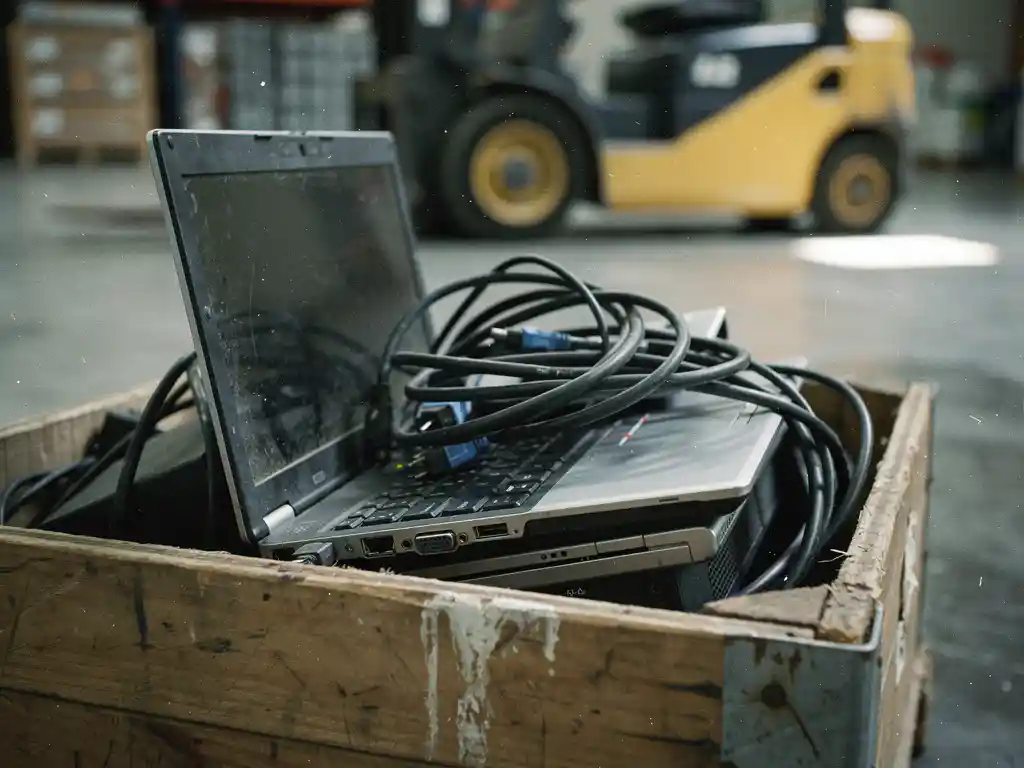
End-of-life IT equipment should be decommissioned through a structured process that includes secure data destruction, regulatory-compliant disposal, and responsible recycling or resale. Improper handling creates serious legal, financial, and environmental risks for any organization. The questions below address each stage of that process, from understanding the risks to choosing the right logistics partner.
What are the risks of improper IT equipment disposal?
Improperly disposing of end-of-life IT equipment exposes organizations to data breaches, legal penalties, environmental harm, and reputational damage. Hard drives and storage media that are not securely wiped before disposal can retain sensitive corporate, financial, or personal data, making them targets for recovery by malicious parties even after the device appears non-functional.
Beyond data security, discarding IT equipment through general waste streams violates environmental legislation in most countries. Electronic devices contain hazardous materials including lead, mercury, and cadmium, which can leach into soil and water when sent to landfill. Organizations that ignore this risk face regulatory fines and potential litigation.
There is also a reputational dimension. A data breach traced back to a carelessly discarded laptop or server can cause lasting damage to customer trust and brand credibility. For businesses operating in regulated industries such as finance or healthcare, the consequences can extend to license restrictions or mandatory public disclosure of the incident.
What is IT asset disposal (ITAD) and how does it work?
IT asset disposal, commonly referred to as ITAD, is the structured process of decommissioning, collecting, transporting, and processing end-of-life IT equipment in a way that protects data, complies with regulations, and recovers residual value where possible. It covers everything from individual laptops to entire server rooms and data center infrastructure.
A typical ITAD process follows several defined stages:
- Inventory and audit: All equipment is catalogued, including serial numbers, asset tags, and condition assessments.
- Data destruction: Storage media are wiped or physically destroyed before the device leaves the organization’s control.
- Collection and transport: Decommissioned assets are collected securely and transported to a certified processing facility.
- Sorting and assessment: Equipment is evaluated for refurbishment, resale, component harvesting, or recycling.
- Certification: The organization receives documented proof of data destruction and disposal, which is essential for compliance purposes.
The goal of ITAD is not simply to remove old equipment but to do so in a way that eliminates risk, satisfies legal obligations, and ideally recovers some economic value from assets that still have market worth.
How should data be securely wiped from old IT equipment?
Data should be securely wiped from old IT equipment using one of three recognized methods: software-based overwriting, degaussing, or physical destruction. The right method depends on the sensitivity of the data stored, the type of storage media, and whether the device will be reused or destroyed entirely.
Software-based data wiping
This method uses certified data erasure software to overwrite all sectors of a storage drive with random data, making the original content unrecoverable. It is suitable for devices that will be resold or donated, as the hardware remains intact and functional. The process should be verified with a completion certificate from the software tool used.
Degaussing and physical destruction
Degaussing uses a powerful magnetic field to scramble data on magnetic storage media such as traditional hard disk drives. Physical destruction, including shredding or crushing, is the most definitive method and is typically used for highly sensitive data environments where no residual risk is acceptable. Solid-state drives (SSDs) require physical destruction rather than degaussing, as they are not affected by magnetic fields in the same way.
Regardless of the method chosen, organizations should always obtain a certificate of data destruction as documented evidence that the process was completed to an auditable standard.
What are the legal requirements for disposing of IT equipment?
The legal requirements for disposing of end-of-life IT equipment vary by country but generally cover two areas: data protection and environmental compliance. In the European Union, both are governed by robust frameworks that carry significant penalties for non-compliance.
Under the General Data Protection Regulation (GDPR), organizations are required to ensure that personal data stored on decommissioned devices is irreversibly destroyed before disposal. Failure to do so can result in fines of up to 4% of global annual turnover or 20 million euros, whichever is higher. This obligation applies regardless of whether the equipment is recycled, resold, or physically destroyed.
On the environmental side, the EU’s Waste Electrical and Electronic Equipment (WEEE) Directive requires that electronic equipment be collected, treated, and recycled through approved channels rather than sent to general waste. Organizations are responsible for ensuring that their disposal partners hold the appropriate WEEE certification and that disposal is properly documented.
In practice, this means organizations should only work with certified ITAD providers who can supply the paperwork to demonstrate that both data destruction and environmental disposal were handled in accordance with applicable law. Keeping these records is important, as regulators may request them during audits.
Should IT equipment be refurbished, resold, or recycled?
End-of-life IT equipment should be refurbished or resold whenever the device retains functional value and data can be securely removed. Recycling is the appropriate path when equipment is beyond economical repair or when the nature of the data stored makes physical destruction of storage media necessary. A responsible ITAD process evaluates each asset individually rather than applying a single approach to the entire decommissioning batch.
Refurbishment and resale offer clear advantages. They extend the useful life of devices, reduce electronic waste, and can generate a financial return that offsets the cost of the ITAD process. Devices that are only a few years old and still meet minimum performance thresholds are strong candidates for secondary markets, including educational institutions, smaller businesses, and refurbishment charities.
Recycling becomes the correct choice when hardware is too outdated or damaged to be resold, or when the storage media must be physically destroyed. In these cases, certified e-waste recyclers recover valuable raw materials including gold, copper, and rare earth elements, diverting them from landfill and returning them to the supply chain.
We apply this same logic of circularity in our own operations. Our contract logistics services include a refurbishment offering that gives products a second life rather than treating end-of-life as a disposal problem. The principle of recovering value before recycling is one we apply across industries, including high-tech logistics.
Who should handle the collection and transport of decommissioned IT assets?
Collection and transport of decommissioned IT assets should be handled by a certified logistics partner with documented experience in secure, chain-of-custody transport. This is not a task suited to general courier services. IT equipment in transit is vulnerable to data theft, physical damage, and loss of traceability, all of which create liability for the organization handing it over.
A qualified partner will provide a clear chain of custody from the moment equipment leaves your premises to the point of processing. This means every asset is tracked, every handover is documented, and the organization retains a complete audit trail. For large-scale decommissioning projects involving multiple sites or international locations, the logistics complexity increases significantly and requires a partner with genuine project management capability.
Our project logistics team handles exactly this kind of complex, multi-location assignment, coordinating transport, warehousing, and administrative processes across borders. Whether the project involves a single office clearance or a coordinated rollout across dozens of locations, the same principles apply: secure handling, full documentation, and a single point of accountability throughout.
When evaluating a logistics partner for IT asset disposal, look for the following:
- Certified chain-of-custody procedures with documented handover records
- Experience with secure transport of sensitive or high-value equipment
- Ability to coordinate collection across multiple sites or countries
- Integration with certified ITAD processing facilities
- Clear reporting and certification upon completion
Choosing the right partner at this stage protects the organization not just from logistical risk but from the legal and reputational exposure that comes with any gap in the disposal chain. If you want to discuss how we can support your IT decommissioning logistics, get in touch with our team directly.