


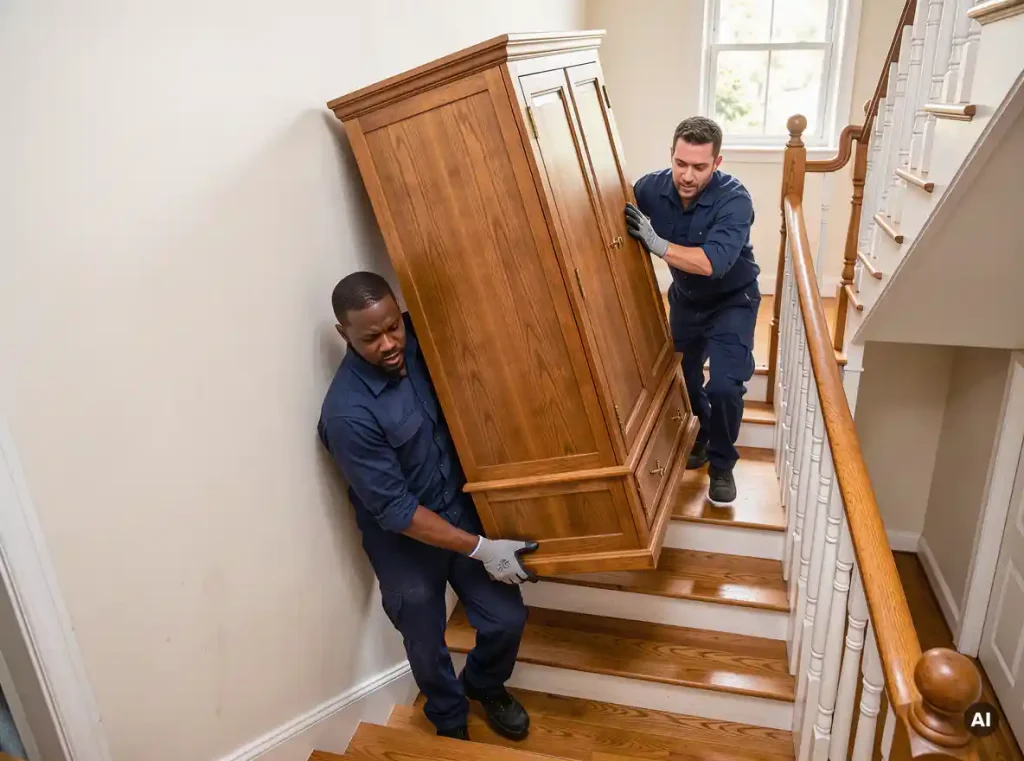
The five essential safety checks before lifting heavy furniture upstairs are: plan and clear the route, use proper lifting technique, bring the right equipment, have enough people, and know when to stop and call professionals. Skipping any one of them raises the risk of injury and damage.
These checks apply whether you are moving a sofa, a wardrobe, or a solid oak table. Here is how each one works, so you can carry furniture upstairs safely and keep both people and furniture in one piece.
How do you plan the route before carrying furniture upstairs?
Planning the route means measuring the furniture and every doorway, hallway, and stairwell it must pass through, then clearing all obstacles in advance. A confirmed, obstacle-free path is the first and most important safety check when you move heavy furniture up stairs.
Start by measuring the piece at its widest, tallest, and deepest points. Then compare those numbers with door frames, stair width, ceiling height, and any tight corners or landings. Many furniture accidents happen halfway up a staircase when a piece turns out not to fit.
Before you lift, walk the full route and check these points:
- Remove rugs, shoes, plants, and loose items from the path.
- Check that the lighting is good, especially on stairs and landings.
- Make sure handrails are secure and the steps are dry and non-slip.
- Open all doors fully and wedge them in place.
- Decide where the furniture will be set down at the top, and clear that space too.
If the measurements are tight, consider removing legs, doors, drawers, or cushions to make the piece lighter and slimmer. Our team plans every route this way, and our furniture transport service builds that preparation into each delivery.
What is the safest lifting technique for heavy furniture on stairs?
The safest lifting technique is to bend at the knees, keep your back straight, hold the load close to your body, and lift with your legs rather than your back. On stairs, move slowly, take one step at a time, and never twist your torso while carrying.
Good lifting technique for heavy furniture comes down to a few habits:
- Set your stance. Place your feet shoulder-width apart for balance.
- Bend your knees. Squat down instead of folding at the waist.
- Grip firmly. Use solid handholds, not slippery edges or delicate trim.
- Keep the load close. The further the weight is from your body, the more strain it puts on your back.
- Turn with your feet. Pivot your whole body instead of twisting at the waist.
On stairs, the person going up should walk backwards or sideways only if they can see clearly, ideally guided by a spotter. The stronger person usually takes the lower end, since that end carries more of the weight when going up. Communicate constantly with simple calls such as “lifting,” “stepping,” and “stopping,” and always agree on a signal to set the furniture down immediately if anyone loses their grip.
What equipment makes carrying furniture upstairs safer?
The most useful equipment for carrying furniture upstairs includes lifting straps, furniture sliders, a hand truck or stair-climbing dolly, moving blankets, and work gloves with good grip. These tools reduce strain, protect surfaces, and keep the load stable on every step.
Each item has a specific job:
- Lifting straps: These shift weight onto your legs and shoulders and let two people carry heavy pieces with less grip fatigue.
- Furniture sliders: These help you move heavy items across floors without lifting, so you only lift when you must.
- Hand truck or stair dolly: These are ideal for boxed items, appliances, and dense pieces like chests of drawers.
- Moving blankets: These protect finishes and walls, and they add grip. We often transport goods loosely wrapped in furniture blankets instead of single-use packaging, which is better for both the furniture and the environment.
- Gloves and sturdy shoes: Closed shoes with a solid sole prevent slips, and gloves improve your hold.
Check that every piece of equipment is in good condition before you start. Frayed straps or a wobbly dolly can turn a manageable job into a dangerous one.
How many people does it take to lift heavy furniture upstairs?
Most heavy furniture needs at least two people to carry it upstairs safely, and large or awkward pieces such as wardrobes, sofas, and kitchen units often need three or four. The right number depends on weight, size, shape, and how tight the staircase is.
As a practical guide, use these questions to decide:
- Can each person lift their share comfortably without strain?
- Does anyone need to stand in a position where they cannot see the others?
- Is there a turn or landing that needs a spotter to guide the piece?
If the answer to the last two is yes, add another person. A spotter does not carry anything but watches clearances, calls out obstacles, and helps steady the load. Everyone involved should be physically able to do the job. Never let someone take part just because they are available.
For kitchens and other fragile, high-value items, we always send two trained professionals, and a final inspection is done before departure. That level of staffing reflects how much easier and safer a job becomes with the right number of skilled hands.
When should you call professional movers instead of doing it yourself?
You should call professional movers when the furniture is very heavy, valuable, or fragile, when the staircase is narrow, steep, or winding, or when you lack enough capable helpers. If any safety check fails and you cannot fix it, professional help is the safer and often cheaper choice.
Consider professional furniture movers in these situations:
- The piece is too heavy for the team available, or its weight is uneven or unknown.
- The staircase is tight, spiral, or has several turns and landings.
- The furniture is expensive, antique, or hard to replace.
- Anyone involved has back problems or a previous injury.
- You need assembly or installation at the destination as well as carrying.
Specialists bring training, tools, and experience that most households simply do not have. We have been handling furniture since 1924, and our own staff are trained in-house with a strong focus on respect and care for every piece. For larger moves, such as offices, hotels, or schools, our project logistics team manages delivery and installation from start to finish.
If you are unsure whether a job is safe, you can always get in touch with us for advice. A short conversation beforehand costs far less than an injury or a damaged heirloom.