


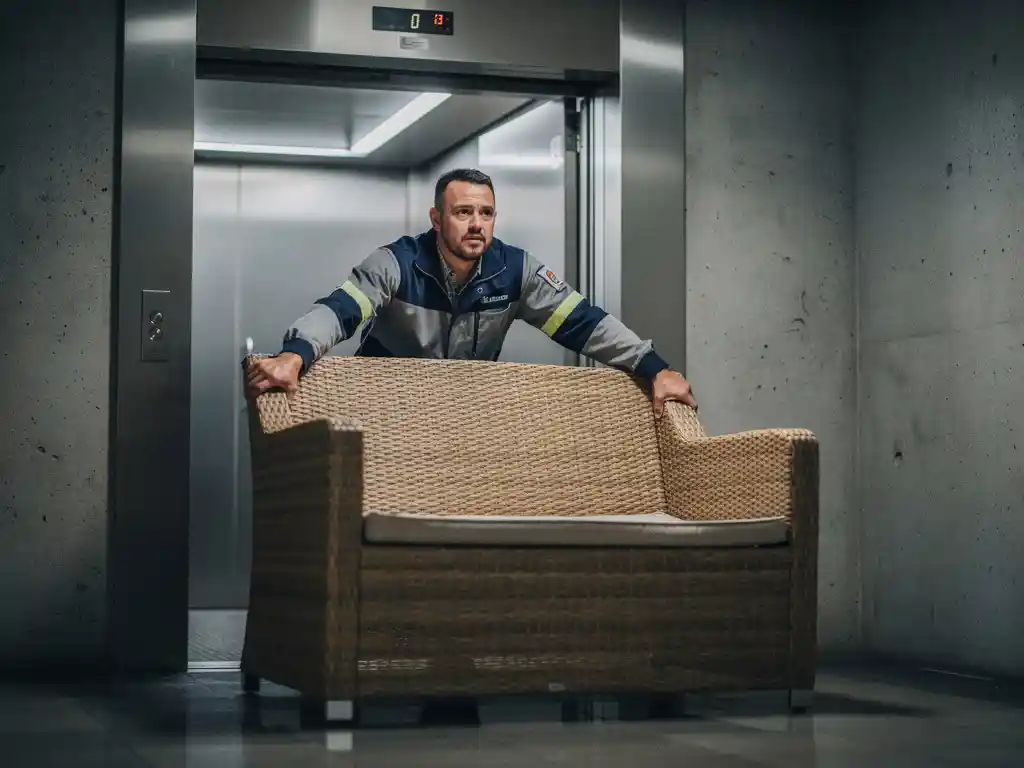
Delivering outdoor furniture to a high-rise apartment building is significantly more challenging than a standard ground-floor delivery. Bulky, heavy items like garden sofas, dining sets, and sun loungers must navigate tight lobbies, restricted elevators, and sometimes multiple flights of stairs, all while staying protected from damage. The sections below break down the specific obstacles involved and how to overcome them.
Why is outdoor furniture harder to deliver than indoor furniture?
Outdoor furniture is harder to deliver than indoor furniture because it is typically larger, heavier, and built from durable materials like metal, teak, or rattan that add significant bulk and weight. Unlike standard indoor pieces, outdoor furniture is often designed for open spaces and rarely accounts for the confined corridors and access points of a residential building.
A garden dining table, for example, might have a wide surface area and a heavy stone or cast aluminium top that makes it awkward to manoeuvre, even with two people. Outdoor sofas frequently come with thick, oversized cushions that are packaged separately, adding extra trips and complexity. Parasols and pergola components can be several metres long, making them almost impossible to transport through standard doorways without disassembly.
The combination of size, weight, and material density means that delivering outdoor furniture to an apartment building demands more planning, more people, and more specialist equipment than most indoor furniture deliveries.
What access obstacles do delivery crews face in high-rise buildings?
Delivery crews tackling furniture delivery in an apartment building face a range of physical access obstacles, including narrow entrance doors, tight lobby corridors, restricted parking zones, and long distances from the building entrance to the final delivery floor. Each of these barriers adds time, effort, and the risk of product damage.
Common access challenges include:
- Restricted parking: Many high-rise buildings in urban areas have no direct loading bay, forcing crews to park at a distance and carry items further on foot.
- Narrow lobbies and corridors: Building hallways are often designed for pedestrian traffic, not large furniture pieces, meaning items must be tilted, rotated, or partially disassembled to pass through.
- Secured entry points: Access control systems, key fob doors, and intercom delays can slow the process considerably, especially when crews are moving multiple loads.
- Stairwells as a last resort: When elevators are unavailable or too small, stairwells become the only option, raising the physical demands on the crew and the risk of damage to both the product and the building.
Pre-visit site assessments are one of the most effective ways to identify these obstacles before delivery day, avoiding costly surprises on arrival.
How do elevator size and weight limits affect outdoor furniture delivery?
Elevator size and weight limits are among the most significant constraints in high-rise furniture logistics. Residential elevators are typically designed for passenger use, with limited floor space and weight capacities that often fall well short of what a large outdoor furniture set requires. A single garden dining table with chairs can easily exceed both the dimensional and load limits of a standard lift.
When the elevator cannot accommodate a piece, the delivery team must either disassemble the item, use the stairwell, or, in rare cases, arrange for an external hoist. Each of these alternatives adds time and cost to the job. Disassembly is only possible for modular pieces, and not all outdoor furniture is designed to be taken apart on site.
It is also worth noting that some building managers place additional restrictions on elevator use during deliveries, such as time windows or requirements for protective padding to prevent damage to lift interiors. These restrictions can further compress the available delivery window and require careful coordination with building management in advance.
What logistical planning is needed before delivering to a high-rise?
Successful outdoor furniture delivery to a high-rise requires thorough logistical planning well before the delivery vehicle leaves the depot. Without preparation, even a straightforward order can turn into a costly, time-consuming operation that ends in a failed delivery.
Key planning steps include:
- Site survey: Confirm elevator dimensions, weight limits, corridor widths, and parking availability before scheduling the delivery.
- Building management coordination: Notify the building manager or concierge in advance to arrange access, reserve the service elevator if available, and understand any building-specific rules.
- Crew sizing: Assign enough team members based on the weight and volume of the items, particularly for upper-floor deliveries where stairwells may be involved.
- Equipment preparation: Bring appropriate tools such as furniture dollies, straps, lifting equipment, and protective blankets to handle bulky pieces safely.
- Delivery window agreement: Confirm a realistic time window with the customer that accounts for the extra complexity of a high-rise delivery.
For large-scale or commercial projects, project logistics planning adds another layer, coordinating multiple deliveries across different floors or units within the same building.
How does high-rise delivery affect packaging and product safety?
High-rise delivery puts significantly more stress on packaging than a standard ground-floor drop-off. The additional handling involved in navigating elevators, stairwells, and long corridors increases the number of times a product is set down, tilted, or repositioned, each of which creates an opportunity for packaging to fail and the product to be damaged.
Outdoor furniture, which often features powder-coated metal frames, glass tabletops, or woven synthetic materials, is particularly vulnerable to scratching and denting during extended handling. Packaging that is adequate for a short van-to-door journey may not be robust enough for a multi-floor apartment building delivery.
Professional logistics providers address this by using reinforced packaging, corner protectors, and protective wrapping that stays on the product throughout the entire delivery journey, not just during transport. Our furniture transport service is built around protecting vulnerable items at every stage, from the warehouse to the final room of placement.
Customers can also help by ensuring that packaging is not removed until the item has reached its final position, reducing the risk of surface damage during the last stage of the delivery.
When should you use a specialist logistics partner for high-rise furniture delivery?
You should use a specialist logistics partner for high-rise furniture delivery when the items are large or heavy, the building presents significant access challenges, or the delivery is part of a larger project involving multiple units or floors. Attempting a complex bulky furniture delivery without the right expertise, equipment, and planning increases the risk of product damage, building damage, and failed deliveries.
Specialist partners bring several advantages that a standard courier or removal company cannot match:
- Experienced crews trained in handling oversized and heavy items in confined spaces
- Access to specialist lifting and carrying equipment
- Established processes for coordinating with building management
- Proper packaging and protection standards throughout the delivery chain
- The ability to handle assembly and installation on site once the item has been delivered
For developers and retailers managing furniture delivery across multiple high-rise units, a specialist partner becomes even more valuable. We operate across more than 150 locations worldwide through our membership of the Mach 3000 network, giving us the reach and local knowledge to handle complex deliveries wherever they are needed. If you are planning a high-rise furniture project and want to discuss the right approach, get in touch with our team to explore the options.