




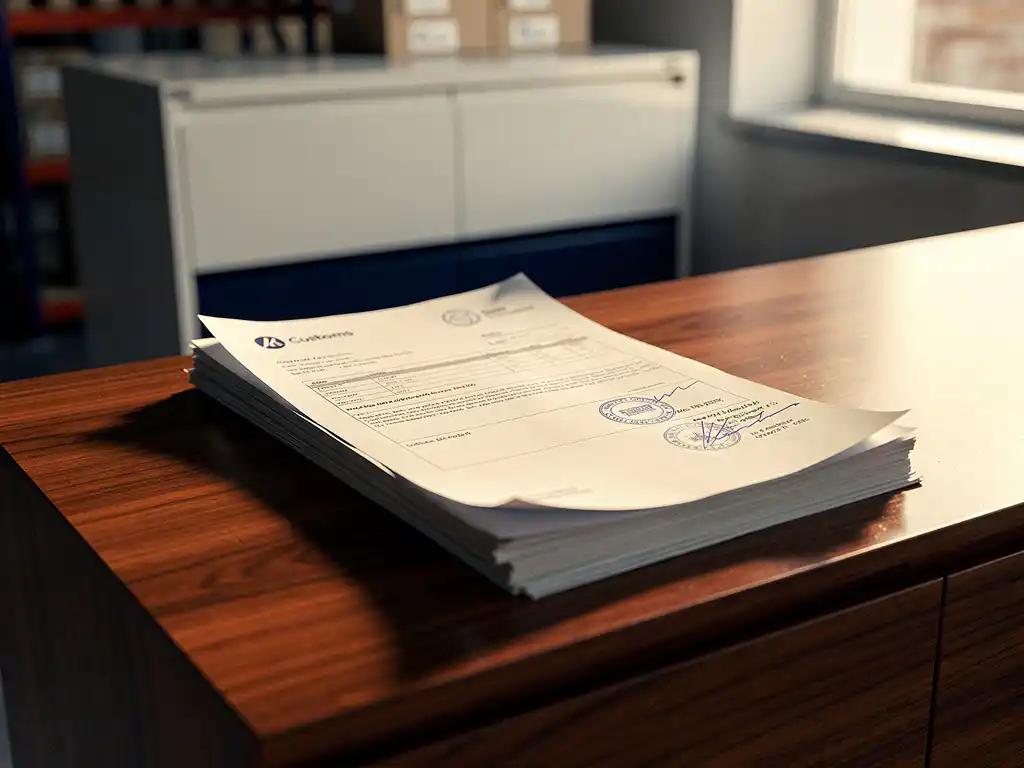
To export furniture outside the EU, you need several key customs documents: an export declaration (submitted through the EU’s customs system), a commercial invoice, a packing list, and, depending on the destination and materials, a certificate of origin and CITES documentation for certain wood types. Getting this paperwork right is essential for legal compliance and avoiding costly delays at the border. The sections below break down each document, when it applies, and what happens if something is missing.
Which customs documents are required for furniture exports?
The core customs documents required for furniture exports outside the EU are a commercial invoice, a packing list, an export declaration, and a bill of lading or airway bill. Depending on the destination country and the materials used in the furniture, you may also need a certificate of origin, a EUR.1 movement certificate, and CITES permits for protected wood species.
Each document serves a specific purpose in the export process. The commercial invoice details the transaction between buyer and seller, including the value, quantity, and description of the goods. The packing list gives customs authorities a precise breakdown of what is in each shipment. The bill of lading or airway bill functions as the contract of carriage between the shipper and the transport provider.
For furniture specifically, accurate product descriptions matter more than many exporters realize. Customs authorities classify furniture under specific HS (Harmonized System) codes, and the correct code determines the applicable duties and any additional documentation requirements at the destination. Misclassification is one of the most common causes of delays in furniture export documentation processing.
What is an export declaration and when is it mandatory?
An export declaration is a formal notification to customs authorities that goods are leaving the EU. For furniture exports outside the EU, an export declaration is mandatory for all commercial shipments regardless of value. It is submitted electronically through the EU customs system and results in an Export Accompanying Document (EAD) with a Movement Reference Number (MRN) that must travel with the goods.
The export declaration captures key data including the exporter’s EORI number, the HS code of the goods, the customs value, the country of destination, and the transport details. Without a valid MRN, the shipment cannot legally leave the EU through a customs office of exit.
For businesses exporting furniture regularly, working with a licensed customs agent or a logistics partner experienced in furniture transport significantly reduces the risk of declaration errors. We handle customs clearance as part of our full-service offering, ensuring declarations are filed correctly and on time before the goods reach the border.
Do you need a certificate of origin for furniture exports?
Whether you need a certificate of origin for furniture exports depends on the destination country and whether a preferential trade agreement applies. A standard certificate of origin confirms where the furniture was manufactured. A EUR.1 movement certificate or a statement on origin (for exporters registered under REX) is required when claiming preferential tariff rates under EU trade agreements with countries such as Japan, Canada, or South Korea.
Even when not strictly required for customs entry, many importing countries request a certificate of origin for statistical, regulatory, or import duty purposes. Some destinations require it to be stamped by a Chamber of Commerce. It is always worth checking the specific import requirements of the destination country before the shipment departs, as requirements vary significantly.
For furniture made from components sourced across multiple countries, determining the correct country of origin involves applying rules of origin criteria, typically based on substantial transformation or a specific manufacturing process. This is an area where errors are common and where professional customs advice adds real value.
What are CITES requirements for wooden furniture exports?
CITES (the Convention on International Trade in Endangered Species) requirements apply to furniture made from or containing wood species listed under CITES Appendices I, II, or III. If your furniture includes materials such as rosewood (Dalbergia species), certain mahogany types, or other protected timbers, you must obtain a CITES export permit before the shipment can legally leave the EU.
CITES Appendix II covers the most commonly encountered restriction for commercial furniture exports. Rosewood, for example, was added to Appendix II in 2017, which significantly affected the trade in solid rosewood furniture and components. An export permit must be issued by the relevant national CITES management authority in the exporting EU member state.
Failing to identify CITES-listed materials in a furniture shipment is not a minor oversight. Shipments can be seized, and penalties under EU Wildlife Trade Regulations can be severe. If you are unsure whether your furniture contains any regulated wood species, check the material specifications with your supplier and consult your national CITES authority or a specialist customs broker before exporting.
How does customs clearance work for furniture shipped outside the EU?
Customs clearance for furniture exported outside the EU follows a structured process that begins before the goods leave the warehouse and ends when the shipment is formally released by the customs office of exit. The exporter or their agent submits the export declaration, the goods are assigned an MRN, and the shipment is presented at the border, where customs may inspect it or release it based on the declaration.
Pre-shipment preparation
Before the goods move, all export documentation must be complete and consistent. The commercial invoice value, the packing list quantities, and the export declaration data must align exactly. Any discrepancy between documents can trigger a customs hold. For large furniture consignments or project shipments, this preparation stage is critical and should be planned well in advance of the departure date.
At the customs office of exit
When the truck or container arrives at the EU border crossing, the customs office of exit verifies the MRN against the goods. Customs may conduct a physical inspection, particularly for high-value furniture or shipments to destinations with elevated risk profiles. Once cleared, the customs office confirms the exit, which completes the EU export procedure and allows the exporter to zero-rate the VAT on the transaction.
For complex shipments involving multiple destinations or consolidated loads, working with a logistics partner experienced in project logistics helps ensure that clearance is coordinated efficiently across every leg of the journey. We operate across more than 150 locations worldwide, which means we understand the clearance requirements at destination as well as at the point of export.
What happens if your furniture export documents are incomplete?
If your furniture export documents are incomplete or contain errors, the shipment will be held at the border until the issue is resolved. Depending on the nature of the problem, this can mean delays of hours or days, additional storage costs, and, in serious cases, refusal of export or seizure of the goods. Incomplete documentation is one of the most preventable causes of supply chain disruption in international furniture logistics.
The most common documentation problems include mismatched values between the invoice and the export declaration, missing or incorrect HS codes, absent CITES permits for regulated materials, and failure to provide a valid EORI number. Each of these triggers a different response from customs, but all result in the shipment being held.
Beyond the immediate delay, incomplete export documentation can have downstream consequences. The importing country’s customs authority relies on the export documentation to process the import declaration. If the export paperwork is inconsistent or missing, it can cause a second round of delays and additional costs at the destination end, even after the shipment has been released from the EU.
The most effective way to avoid these problems is to build a documentation checklist specific to each destination market and to have an experienced customs agent review the paperwork before the shipment moves. If you export furniture regularly, investing in a reliable logistics partner who manages customs clearance as part of the service removes much of this risk from your operations. Feel free to get in touch with us to discuss how we can support your export documentation process from start to finish.