




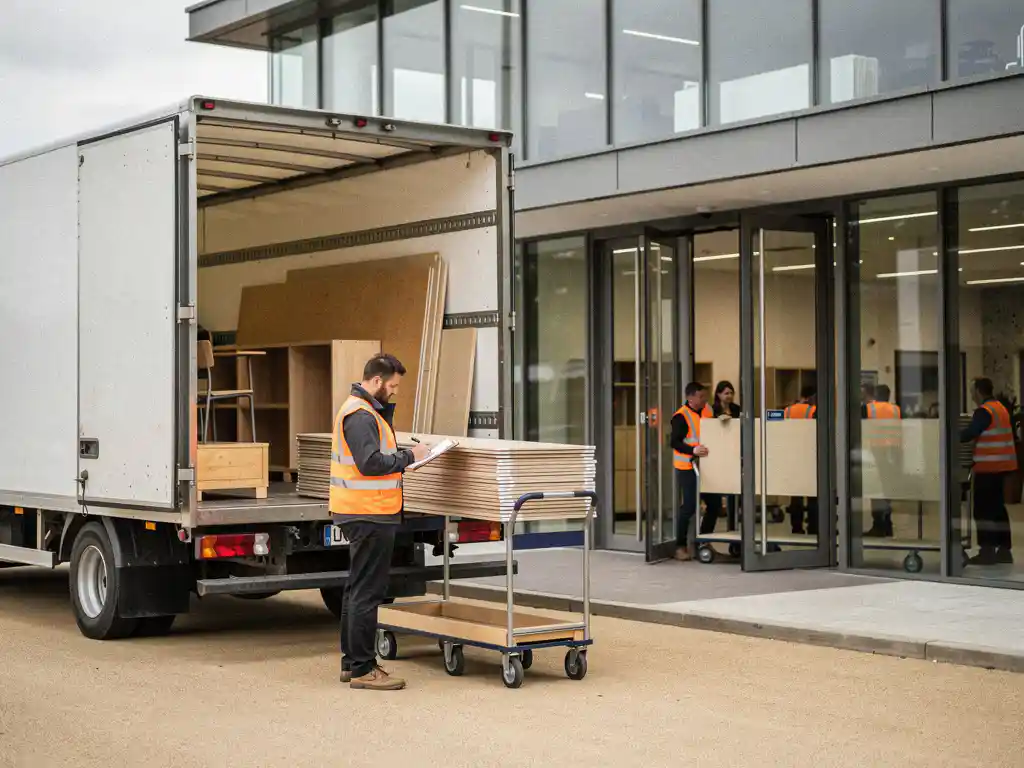
Logistics management for fit-out projects involves coordinating the end-to-end movement, storage, and installation of furniture, fixtures, and equipment across a defined project timeline. Unlike standard freight, it requires precise sequencing, site-specific planning, and close collaboration between suppliers, contractors, and installation teams. The sections below break down exactly what that coordination looks like in practice.
What makes fit-out project logistics different from standard freight?
Fit-out project logistics differs from standard freight because delivery timing, sequencing, and on-site handling are as critical as the transport itself. Items must arrive in the right order, at the right moment, to support installation crews working to a fixed programme. A delayed pallet or a mis-sequenced delivery does not just slow one task; it can cascade across the entire project schedule.
Standard freight focuses on moving goods from point A to point B safely and efficiently. Project fit-out supply chain management adds several layers on top of that: multi-supplier consolidation, phased delivery windows, customs clearance for international items, last-mile handling in buildings that may still be under construction, and real-time communication with site managers. The goods themselves are often high-value and fragile, including bespoke furniture, kitchen units, and specialist fixtures that cannot simply be reordered if damaged. That combination of time pressure, complexity, and product sensitivity is what sets fit-out logistics apart.
What does a logistics manager actually coordinate in a fit-out project?
In a fit-out project, a logistics manager coordinates supplier timelines, consolidation of goods, transport planning, customs documentation, site access scheduling, and installation sequencing. Their role sits at the intersection of procurement, construction management, and transport operations, keeping every moving part aligned with the project programme.
On a practical level, this means tracking inbound shipments from multiple manufacturers, often across different countries, and consolidating them into a coherent delivery plan. The logistics manager communicates with the main contractor to understand site readiness, floor access, and lift availability, then schedules deliveries in the sequence that installation teams need. When items arrive from outside the EU, they manage customs and freight documentation to prevent clearance delays from disrupting the programme.
They also act as the first responder when things go wrong. A supplier ships late, a lorry is turned away from site, or a consignment arrives damaged. The logistics manager identifies the problem, assesses the impact on the programme, and organises a solution, whether that means expediting a replacement, rescheduling a delivery window, or sourcing temporary storage at short notice.
How does warehousing support fit-out project delivery?
Warehousing supports fit-out project delivery by providing a controlled buffer between supplier lead times and site readiness. Goods can be received, inspected, and held until the site is ready to accept them, preventing costly delays caused by early deliveries arriving before installation can begin.
In practice, a fit-out project rarely has a perfectly linear supply chain. Some items arrive weeks ahead of schedule while others run late. Without a dedicated warehousing solution, project teams face a difficult choice: accept early deliveries onto a congested or unready site, or ask suppliers to hold goods and risk further delays. A logistics warehouse solves this by receiving all goods on the supplier’s schedule, performing quality checks, and releasing items to site in the exact sequence the installation programme requires.
Value-added services within the warehouse also reduce on-site labour. Pre-assembly, labelling, kitting, and packaging removal can all happen in the warehouse environment, where conditions are controlled and teams are not working around active construction. This means installation crews on site spend their time installing rather than unpacking, which keeps the programme on track.
What are the biggest logistics risks in a fit-out project?
The biggest logistics risks in a fit-out project are supplier delays, sequencing failures, site access restrictions, damage to high-value items, and customs clearance hold-ups on international shipments. Any one of these can stall installation work and push the project past its handover deadline.
Sequencing failures are particularly disruptive. If raised flooring arrives after workstations, or kitchen carcasses arrive before the structural fit-out is complete, items either block the site or have to be moved repeatedly, increasing the risk of damage and wasting installation time. Effective project logistics planning maps every item against the installation sequence before a single delivery is booked.
Damage risk is heightened in fit-out projects because many items are bespoke or have long lead times. A scratched worktop or a broken glass partition cannot always be replaced quickly, and the delay ripples through the programme. Proper packaging specifications, trained handling crews, and in-warehouse inspection processes are the practical controls that reduce this risk.
International sourcing adds customs complexity. Furniture and fixtures sourced from outside the EU require accurate commodity codes, correct valuation, and timely documentation. A clearance hold of even a few days can be enough to miss a critical installation window on a fast-track project.
When should a fit-out project bring in a dedicated logistics partner?
A fit-out project should bring in a dedicated logistics partner as early as the procurement phase, before suppliers are confirmed and delivery schedules are set. Involving a specialist at this stage means logistics constraints shape the supply plan rather than being bolted on afterwards when problems are harder to fix.
For smaller, single-floor refurbishments with a handful of local suppliers, a general contractor may manage logistics internally. But as the project scale, supplier count, or geographic complexity increases, the case for a specialist becomes clear. Projects spanning multiple floors, involving international sourcing, or running to a tight handover deadline benefit significantly from a partner with dedicated project logistics expertise.
We work on fit-out projects across more than 150 locations worldwide, from single office floors to full hotel fit-outs and school buildings delivered during holiday windows. Our project team uses site plans and data to map every logistics process before work begins on location, and we travel to site with local partners to manage planning and coordination directly. When something unexpected happens, having a logistics partner who can act quickly and think creatively around the problem is what keeps the project moving.
The right time to engage is before the programme is locked. Waiting until goods are ready to ship leaves little room to optimise sequencing, consolidate freight efficiently, or build contingency into the plan. Early involvement turns logistics management from a reactive function into a genuine enabler of project success.