


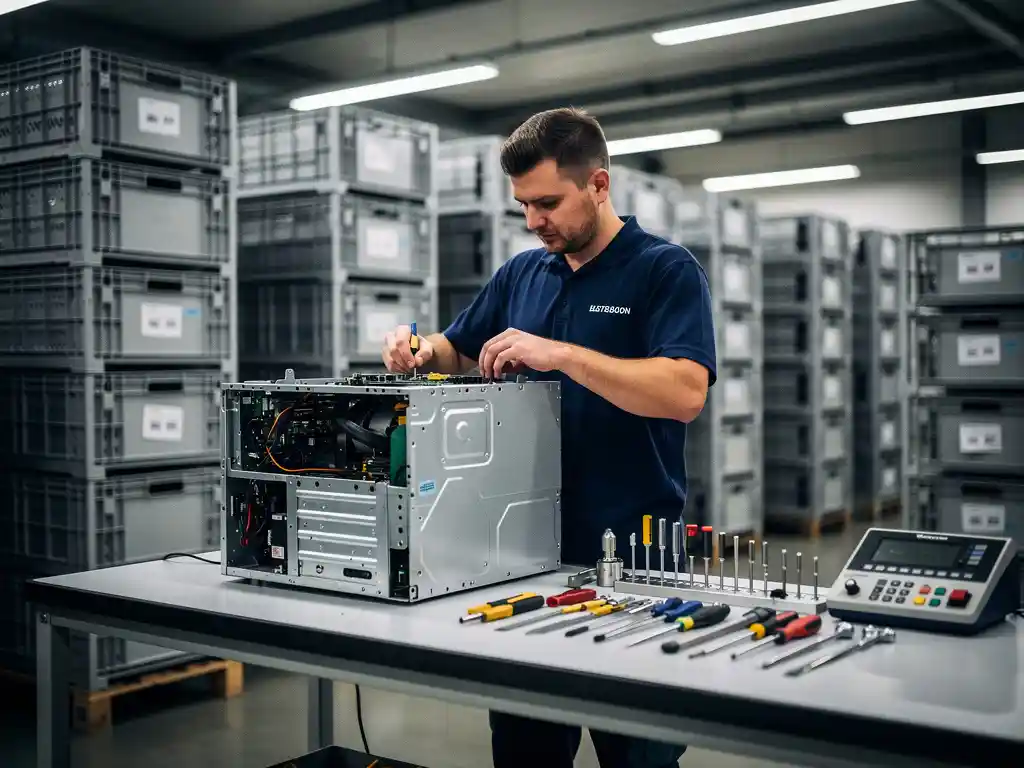
Professional assembly of high-tech equipment involves trained technicians receiving, inspecting, configuring, and installing complex hardware in a controlled, methodical way that protects both the equipment and the end user. It goes well beyond unpacking and plugging in a device. The process demands specialist knowledge, the right physical environment, and seamless coordination with transport and warehousing operations. The sections below answer the most common questions businesses have before committing to professional assembly services.
What types of high-tech equipment require professional assembly?
High-tech equipment that requires professional assembly includes server cabinets and IT infrastructure, medical devices, industrial machinery, telecommunications hardware, and complex audiovisual systems. These are products where incorrect assembly creates safety risks, voids warranties, or causes immediate operational failure. The defining factor is not size or cost alone, but the degree to which assembly errors have serious downstream consequences.
Server cabinets are a clear example. Rack-mounted servers, patch panels, switches, and cable management systems must be installed in a precise sequence, with correct torque on mounting hardware, proper airflow planning, and clean cable routing. A mistake at this stage can cause overheating, connection failures, or data loss. Similarly, medical imaging equipment and laboratory instruments contain sensitive calibration settings that can be disrupted by vibration during transport and must be recalibrated by a specialist during installation.
Industrial automation equipment, including robotic arms, conveyor systems, and CNC machinery, also falls into this category. These systems involve electrical, mechanical, and software components that must be aligned and tested together before the equipment is considered operational. Audiovisual infrastructure in corporate environments, such as video walls, control room displays, and integrated conferencing systems, requires the same level of precision.
What these categories share is complexity, interdependence of components, and the need for verification testing after assembly. If a product can be assembled incorrectly in a way that is not immediately visible but causes failure weeks later, it requires professional assembly.
What skills and certifications do professional assembly technicians need?
Professional assembly technicians working with high-tech equipment need a combination of technical trade skills, product-specific knowledge, and relevant certifications depending on the equipment type. Core competencies include mechanical assembly, basic electrical knowledge, cable management, and the ability to read technical documentation and wiring diagrams accurately.
For IT and server infrastructure, technicians benefit from familiarity with data centre standards and vendor-specific installation requirements. Many hardware manufacturers require installers to complete certified training before warranty coverage applies, making vendor certification a practical necessity rather than a differentiator. For medical or laboratory equipment, regulatory frameworks in many countries require installation to be performed or supervised by a qualified engineer.
Beyond technical credentials, professional assembly technicians working in logistics-integrated environments need skills that are often overlooked:
- Damage assessment: The ability to identify transit damage before assembly begins, so defective components are flagged before installation rather than after.
- Documentation: Accurate recording of serial numbers, configuration settings, and installation steps to support warranty claims and future servicing.
- Clean room awareness: For sensitive electronics, understanding contamination risks and working within controlled environments.
- Communication: Clear handover reporting to clients and end users, particularly when assembly is part of a larger project rollout.
We invest heavily in internal training at Jan Krediet. Our specialist team combines experienced professionals with trained younger talent, a model that keeps technical knowledge current while preserving the hands-on expertise built over decades of complex project work.
How does the assembly process work from delivery to sign-off?
The professional assembly process for high-tech equipment follows a structured sequence: goods reception and inspection, controlled storage, pre-assembly preparation, on-site or in-warehouse assembly, functional testing, and formal sign-off. Each stage has defined quality checks to prevent errors from carrying forward into the next phase.
Reception and inspection
When equipment arrives, trained staff check each item against the delivery manifest, inspect packaging for transit damage, and log serial numbers. This step is critical because damage that goes unrecorded at reception becomes a disputed liability later. For sensitive electronics, reception often takes place in a controlled environment to avoid exposing components to dust or static.
Assembly and testing
Assembly follows the manufacturer’s technical specifications, with technicians working from documented procedures rather than improvising. For server cabinets, this means mounting hardware in the correct sequence, managing cable runs to maintain airflow, and applying correct labelling before the cabinet is powered on. Once assembled, the equipment goes through functional testing to verify that every component operates as expected. Any configuration required before deployment, such as firmware updates or BIOS settings, is completed at this stage.
Sign-off involves a final review against the project specification, documentation of the completed configuration, and a handover record that the client or their representative confirms. This creates a clear audit trail that supports both warranty claims and future maintenance. We handle this complete cycle for clients including major IT solutions providers, assembling server cabinets in a dedicated dust-free clean room within our warehouse before worldwide distribution.
What can go wrong with improper high-tech equipment assembly?
Improper assembly of high-tech equipment can cause immediate hardware failure, latent faults that surface weeks after deployment, voided warranties, safety hazards, and significant financial losses from downtime. The consequences are rarely limited to the equipment itself; they extend to the operations that depend on it.
The most common failure modes include:
- Thermal failures: Incorrectly mounted server components or poor cable management restrict airflow, causing processors and storage devices to overheat. This is one of the leading causes of premature hardware failure in data centre environments.
- Connection errors: Cables seated incorrectly or in the wrong ports create intermittent faults that are difficult to diagnose and can corrupt data in storage systems.
- Mechanical stress: Over-tightened or under-tightened mounting hardware causes physical damage to circuit boards and chassis over time, particularly in environments with vibration.
- Calibration loss: Sensitive instruments disturbed during installation without proper recalibration produce inaccurate results, which in medical or scientific contexts has serious consequences.
- Warranty voidance: Many manufacturers specify that installation must be performed by certified technicians. Improper assembly by uncertified personnel voids the warranty, leaving the buyer fully exposed to replacement costs.
Beyond the direct technical failures, there is a business continuity risk. When critical infrastructure is assembled incorrectly and fails during operation, the cost of the repair is rarely the largest expense. Lost productivity, emergency call-out fees, expedited replacement shipping, and reputational damage to the business that deployed the equipment all add up quickly. Professional assembly is, in that sense, a risk management decision as much as a technical one.
How does professional assembly integrate with wider logistics services?
Professional assembly of high-tech equipment integrates with logistics services through a chain that connects warehousing, transport, customs clearance, and on-site installation into a single managed process. When assembly is treated as a standalone activity disconnected from logistics, handover points between teams create delays, damage disputes, and accountability gaps. A fully integrated approach eliminates those gaps.
The integration works in both directions. From the logistics side, assembly benefits from controlled storage conditions, proper handling during inbound transport, and accurate inventory management that ensures the right components arrive together at the right time. From the assembly side, logistics benefits from technicians who can identify damaged goods at reception before they enter the supply chain, and who can prepare equipment for outbound distribution in the correct configuration.
Our project logistics approach reflects this integration directly. For complex deployments, our dedicated project teams manage every phase from initial planning through transport, assembly, installation, and final handover. This is particularly relevant for large-scale rollouts, such as equipping multiple office locations simultaneously, where coordinating assembly across sites requires the same planning discipline as managing the transport schedule.
Customs clearance is another integration point that is often underestimated. High-tech equipment crossing international borders is subject to import regulations, tariff classifications, and documentation requirements that affect delivery timelines. When customs handling sits within the same logistics operation as assembly, delays at the border can be anticipated and built into the project schedule rather than causing last-minute disruption at the assembly stage.
When should a business outsource high-tech equipment assembly?
A business should outsource high-tech equipment assembly when the internal team lacks the specialist skills, certified training, or controlled environment required for the equipment type, or when the scale and complexity of a deployment exceed what an internal team can manage without disrupting core operations. Outsourcing is also the right choice when assembly is part of a larger logistics operation that benefits from a single accountable partner.
The clearest signals that outsourcing is the right decision include:
- Warranty requirements: The manufacturer specifies certified installer qualifications that your internal team does not hold.
- Scale: You are deploying equipment across multiple sites or to a large number of end users simultaneously, and internal resources cannot absorb the volume without delays.
- Sensitivity: The equipment requires a dust-free or static-controlled environment that you do not have in-house.
- International deployment: Equipment is being shipped across borders and assembled at locations where you have no local presence or technical staff.
- Turnkey requirements: The end client or internal stakeholder expects a fully operational system delivered and signed off, with no internal project management resource available to coordinate between transport, assembly, and installation teams.
Businesses that use Jan Krediet for high-tech assembly include organisations rolling out work-from-home infrastructure for employees, where we handle delivery, assembly, and equipment connection on a turnkey basis. The same logic applies to any situation where the end result needs to be operational on arrival, not a collection of components waiting for someone to put them together.
If your business is evaluating whether to outsource assembly as part of a broader logistics solution, our team is available to discuss the specific requirements of your project and how an integrated approach can reduce risk and delivery time.