




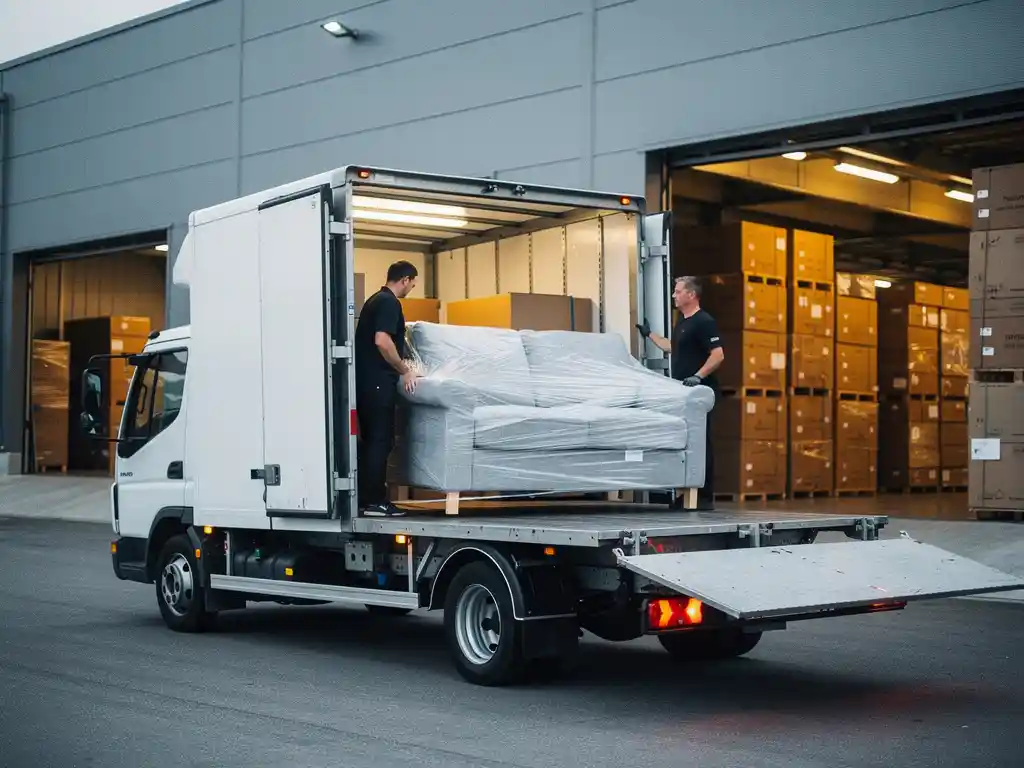
When outsourcing furniture transport, the most important factors are your partner’s experience with fragile goods, the range of services they offer beyond basic delivery, and their ability to protect your end customer’s experience. Furniture is not standard freight, and the logistics partner you choose directly influences how your brand is perceived at the point of delivery. The questions below unpack exactly what to look for, what to ask, and what to expect.
What makes furniture transport different from standard freight?
Furniture transport is fundamentally different from standard freight because furniture items are large, fragile, high-value, and often require handling by trained specialists rather than general freight teams. Unlike palletized goods, furniture pieces vary enormously in shape, weight, and assembly requirements, making standardized freight processes poorly suited to the job.
Standard freight logistics is built around volume, speed, and uniformity. Furniture logistics demands something different: careful handling, protective packaging, climate-aware storage, and often a two-person delivery team capable of navigating staircases, tight corridors, and customer premises. Damage during transit is not just a financial cost but a reputational one, particularly for brands delivering directly to consumers or fitting out commercial spaces.
There is also an assembly dimension. Many furniture items are delivered in flat-pack or component form and require on-site assembly by trained personnel. A general freight carrier is not equipped to offer this. A specialist furniture transport service integrates delivery, assembly, and installation into a single coordinated process, which reduces handover complexity and eliminates the need for multiple contractors.
What services should a furniture transport partner offer?
A capable furniture transport partner should offer a complete service that goes well beyond moving items from A to B. At minimum, look for transport, warehousing, assembly, installation, and returns handling, all coordinated under one roof. The more of the supply chain your partner can manage, the fewer friction points exist between your operation and your customer.
Specifically, the services worth evaluating include:
- Specialist transport with vehicles and equipment designed for oversized or fragile items
- Warehousing and pre-delivery storage with the capacity to hold goods until delivery windows open
- In-warehouse assembly of flat-pack or component-based furniture before dispatch
- On-site installation including furniture, wall decoration, and accessory placement
- Project logistics for large-scale fit-outs, office relocations, or multi-site rollouts
- Returns and reverse logistics to handle damaged, unwanted, or exchanged items efficiently
For businesses operating internationally, membership in a specialist network matters too. We are part of MACH-3000, the leading European network of specialist furniture carriers, which allows us to deliver coordinated project logistics solutions across more than 150 locations worldwide. This kind of network coverage is something a general freight provider simply cannot replicate.
How do you evaluate a logistics partner’s experience in furniture?
To evaluate a logistics partner’s experience in furniture transport, look at how long they have been operating in the sector, what types of furniture clients they serve, and whether their infrastructure, such as vehicles, warehouse space, and staff training, is purpose-built for furniture rather than adapted from general freight operations.
Longevity in the sector is a meaningful indicator. A company that has specialized in furniture logistics for decades will have encountered and solved the edge cases that newer or generalist providers have not. Ask whether their team handles furniture exclusively or as one category among many. Dedicated expertise produces better outcomes than divided attention.
Infrastructure tells a clear story. Relevant indicators include:
- Whether vehicles are configured with protective lining, strapping systems, and appropriate load capacity
- Whether warehouse space is organized specifically for furniture storage, including protection from moisture and pressure damage
- Whether assembly and installation are performed by trained in-house specialists or subcontracted to third parties
- Whether the partner has experience with both residential and commercial furniture delivery environments
Client references and case studies from comparable businesses in your segment are also valuable. A partner with a strong track record in, for example, office fit-outs or high-volume consumer furniture delivery is more likely to understand your specific pressures than one whose furniture experience is incidental.
What questions should you ask before signing a furniture logistics contract?
Before signing a furniture logistics contract, ask directly about damage rates, claims handling, delivery time windows, communication protocols, and how exceptions are managed. These operational specifics reveal far more about a partner’s real capabilities than any sales presentation.
A practical list of questions to raise before committing includes:
- What is your damage rate, and how do you handle claims? A credible partner will have this data and a clear process.
- How do you communicate with end customers ahead of delivery? Proactive communication is a core driver of delivery satisfaction.
- What happens when a delivery cannot be completed? Failed deliveries are costly; understand the escalation process before it happens.
- Can you scale capacity during peak periods? Seasonal demand spikes are common in furniture retail and project logistics.
- What technology do you use for tracking and reporting? Real-time visibility is increasingly a baseline expectation, not a premium feature.
- Who performs assembly and installation, and what is their training standard? In-house teams are generally more accountable than subcontractors.
- What are the contract terms around service level agreements and penalties? Understand what accountability looks like in writing, not just in conversation.
If a prospective partner struggles to answer any of these questions clearly, that itself is a signal. Strong logistics partners are transparent about their operations because they have confidence in them. You can also get in touch with us to discuss your specific requirements before making any commitment.
How does outsourcing furniture transport affect customer satisfaction?
Outsourcing furniture transport to a specialist partner typically improves customer satisfaction when the partner offers reliable delivery windows, professional handling, and clear communication. When done poorly, outsourcing creates the opposite effect: damaged goods, missed appointments, and a customer experience that reflects badly on your brand, not the carrier.
The final delivery moment is often the most emotionally significant touchpoint in a furniture purchase. A customer who has waited weeks for a sofa or a business that has planned an office opening around a delivery date will judge the entire purchase experience on what happens at the door. A specialist furniture delivery service understands this and structures its operations accordingly.
Key ways that the right outsourcing partner improves customer outcomes include:
- Consistent delivery time windows that customers can plan around
- Two-person delivery teams capable of safe room-of-choice placement
- On-site assembly that removes the burden from the customer entirely
- Professional conduct and appearance at the point of delivery
- Fast, fair resolution when something does go wrong
Outsourcing furniture transport also frees your internal team to focus on what they do best, whether that is product development, sales, or customer service, rather than managing the operational complexity of last-mile delivery. When the logistics partner is genuinely capable, outsourcing becomes a competitive advantage rather than a risk. To understand how we approach this end-to-end, visit our company overview or explore our full range of warehousing solutions that support seamless furniture logistics from storage to final delivery.