


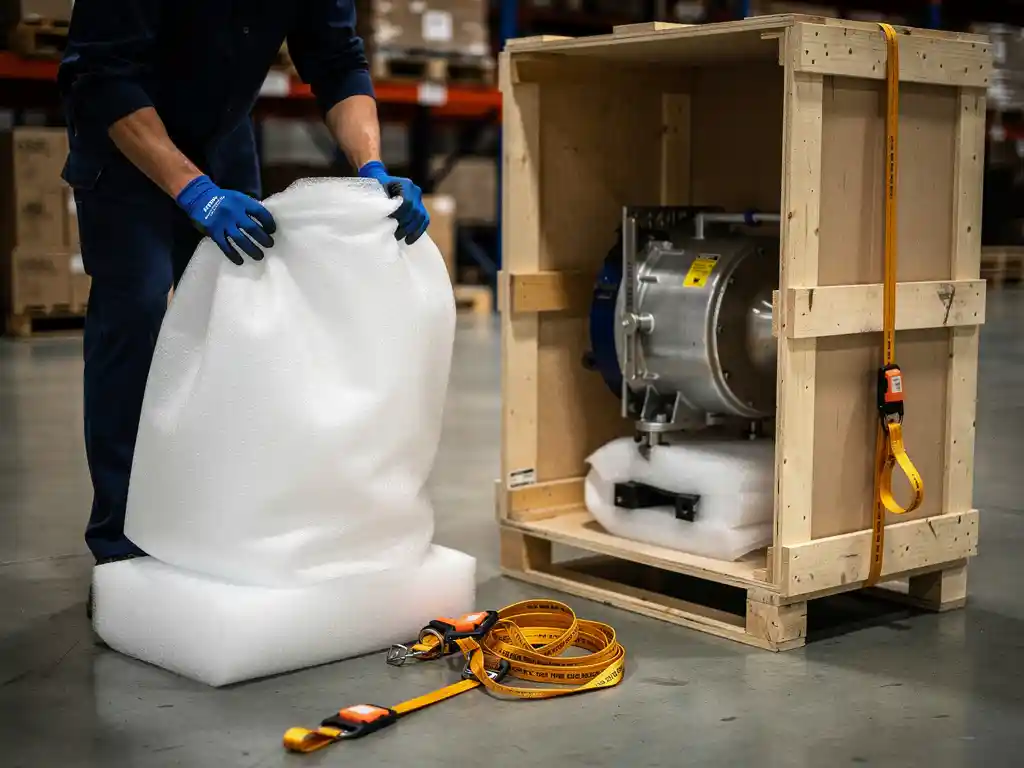
To prevent damage when moving fragile equipment, use purpose-built protective packaging, secure loads firmly to prevent shifting during transit, label items clearly, and work with logistics professionals trained in careful handling. These precautions work together to protect sensitive goods at every stage of the journey, from initial wrapping to final placement at the destination.
Fragile equipment ranges from precision electronics and server hardware to high-end furniture, artwork, and kitchen appliances. Each category demands a tailored approach, because a one-size-fits-all method rarely provides adequate protection. The sections below walk through the most important precautions in detail.
What types of packaging materials best protect fragile equipment?
The best packaging materials for fragile equipment are those that absorb impact, prevent movement, and create a buffer between the item and external forces. Foam inserts, bubble wrap, air cushions, and corrugated cardboard are the most widely used options. For premium or unusually shaped items, custom-cut foam or furniture blankets offer superior protection by conforming to the product’s exact dimensions.
Choosing the right material depends on the weight, fragility, and shape of the item being moved. Lightweight electronics benefit from anti-static foam and rigid outer boxes, while heavy furniture or kitchen units require dense padding and reinforced outer packaging. The goal is always to eliminate any internal movement once the item is packed.
- Foam inserts and custom-cut foam: Ideal for precision equipment and irregularly shaped items that need a snug, immovable fit
- Bubble wrap and air cushions: Effective for lightweight fragile items and filling void space inside boxes
- Furniture blankets: A practical, reusable alternative to single-use packaging for large or premium goods
- Double-walled corrugated cardboard: Provides structural rigidity and impact resistance for outer packaging
- Stretch film and strapping: Secures packaging layers together and prevents wrapping from loosening during transit
Sustainability is also worth considering when selecting materials. Reusable blankets and loose packing methods reduce waste significantly compared to single-use plastic packaging, and they can be just as effective when applied correctly by trained handlers.
How should fragile equipment be loaded and secured in a vehicle?
Fragile equipment should be loaded so that it cannot move, tip, or shift during transit. This means placing heavier items on the floor, lighter and more delicate goods on top, and using straps, load bars, or non-slip matting to hold everything in position. Gaps between items should always be filled with padding to prevent items from colliding.
The loading sequence matters as much as the securing method. Items that will be delivered first should be loaded last so they are accessible without disturbing the rest of the load. This reduces the number of times fragile goods are handled, which directly lowers the risk of damage.
Vehicle design also plays a role. Swap bodies fitted with a double loading floor, for example, increase usable capacity while reducing the number of loading and unloading cycles each item goes through. Fewer handling events mean fewer opportunities for damage to occur. Our general cargo transport operations use exactly this kind of infrastructure to keep fragile goods safe throughout the journey.
For especially sensitive items, a two-person delivery team is the right approach. One person manages the vehicle while the other focuses entirely on safe handling. This is standard practice in kitchen logistics, where products are inspected before departure and carried by two trained professionals at every delivery.
What role does labelling play in protecting fragile goods?
Labelling plays a critical role in protecting fragile goods by communicating handling requirements to every person who comes into contact with the shipment. Clear labels indicating “fragile,” “this side up,” or “do not stack” give handlers the information they need to treat items correctly, even when they have no prior knowledge of the contents.
Effective labelling goes beyond a single sticker. It should be visible from multiple angles, placed on every outer surface of the packaging, and resistant to damage from moisture or abrasion during transit. Colour-coded labels or standardized symbols improve recognition speed, especially in busy warehouse environments where handlers are processing many items at once.
Labels also support accountability. When fragile items are tracked through a logistics chain with clear documentation, it becomes easier to identify where damage occurred if something does go wrong. This is particularly important for high-value goods where insurance claims or quality audits may be required.
For international shipments, labelling must account for language differences. Using internationally recognized symbols rather than text-only instructions ensures that handling requirements are understood regardless of the country the goods pass through.
When should custom crating be used instead of standard packaging?
Custom crating should be used when standard packaging cannot provide adequate protection for the item’s size, weight, fragility, or value. This typically applies to oversized equipment, precision instruments, works of art, server infrastructure, and any item where even minor damage would result in significant financial or operational consequences.
Standard packaging is designed around common dimensions and typical handling conditions. When an item falls outside those parameters, standard solutions introduce risk. A custom crate, by contrast, is built around the specific item, providing a rigid outer shell, internal bracing, and custom-fitted cushioning that eliminates movement entirely.
- Oversized or irregular items: Standard boxes cannot accommodate unusual shapes without leaving dangerous void space
- High-value goods: The cost of a custom crate is small relative to the replacement cost of the item it protects
- Long-distance or international shipments: Goods that travel further face more handling events and greater vibration exposure
- Sensitive technical equipment: Server cabinets, medical devices, and precision instruments require rigid protection that absorbs rather than transmits shock
- Artworks and heritage objects: These items are often irreplaceable, making any level of risk unacceptable
The decision to use custom crating is ultimately a risk assessment. If the consequences of damage outweigh the cost of bespoke packaging, custom crating is the right choice. Our project logistics teams regularly make this assessment when planning the transport of delicate or high-value items across Europe and beyond.
How does professional logistics expertise reduce fragile equipment damage?
Professional logistics expertise reduces fragile equipment damage by combining trained handling techniques, purpose-built infrastructure, and systematic quality checks at every stage of the process. Experienced logistics teams know how to assess risk before a shipment moves, select the right packaging and loading method, and respond effectively when conditions change during transit.
Training is central to this expertise. Handlers who work regularly with fragile or premium goods develop an instinctive understanding of how items behave under different conditions. They know which items need extra support, how to carry awkward loads safely, and when to slow down rather than rush. This kind of practical knowledge cannot be replicated by general-purpose carriers who rarely handle sensitive goods.
We have built our approach to fragile goods logistics on nearly a century of hands-on experience. Our teams are trained internally through our JK Academy, combining on-the-job learning with a strong culture of care and respect for the products we handle. That internal training model means our standards remain consistent regardless of which team or location handles a shipment. You can learn more about the people behind this approach on our team page.
Beyond individual skill, professional logistics providers invest in infrastructure that reduces risk structurally. Real-time tracking, pre-departure inspections, dedicated project managers for complex moves, and quality-controlled warehousing all contribute to a system where damage is prevented by design rather than caught after the fact. When moving fragile equipment without damage is the priority, working with a specialist is consistently the most reliable approach.