


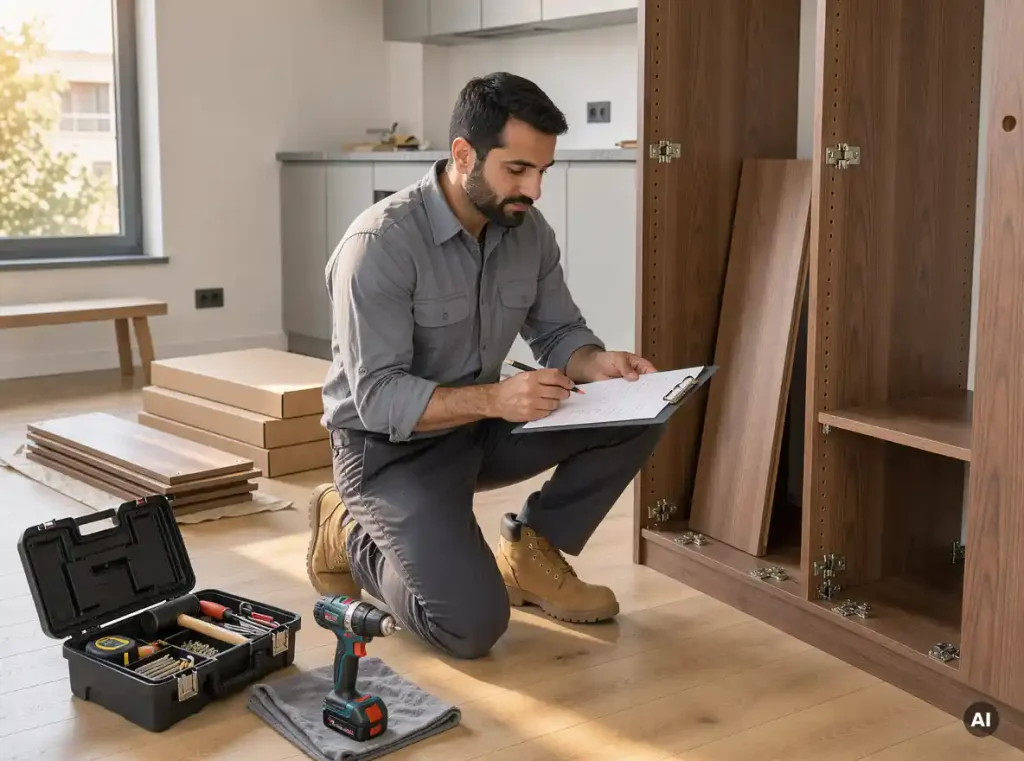
Before outsourcing furniture installation, check five things: the provider’s credentials and track record, insurance and liability terms, installation quality and damage handling, capacity for your volume and timing, and the contract and cost structure. A partner who passes all five protects your products, your schedule, and your customer reviews.
The right check depends on whether you deliver to private homes, offices, hotels, or large projects, but the core questions stay the same. We have handled furniture logistics since 1924, and furniture transport and installation is still the heart of what we do. Below we walk through the questions we would ask ourselves if we were choosing a provider.
Which credentials and experience should an installation partner have?
A furniture installation partner should have proven experience with your product category, trained in-house installers, and recognized management certifications. Ask for references from comparable projects, and check whether installers are employees or subcontractors, because training and accountability differ greatly between the two.
Furniture logistics is a specialized profession. Handling premium sofas, high-end kitchens, or complex office systems requires different skills than moving standard freight. Look for these signs of real expertise:
- Brand and sector references: experience with manufacturers or dealers in your segment, whether premium furniture, kitchens, or office interiors.
- Internal training: a structured academy or on-the-job programme, not just a quick induction.
- Project track record: examples of multi-location or multi-party installations delivered on time.
- Certifications: for instance ISO 14001 for environmental management, which also shows how seriously a company treats processes and standards.
We train our own people, combining on-the-job learning with a strong focus on respect and care for furniture. You can read more about how we work on our standards page, and our customer cases show the kind of work we have delivered.
What insurance and liability terms should be in place?
A provider should carry goods-in-transit insurance, general liability cover, and clear written terms stating who pays when furniture is damaged during transport, handling, or installation. Ask for the actual policy conditions, coverage limits, and excess amounts before signing, not just a statement that you are insured.
Furniture installation damage liability is where many outsourcing arrangements go wrong. Vague wording leaves you paying for a damaged piece while the provider points to a clause. Clarify these points upfront:
- Scope of cover: does it include loading, transport, unloading, carrying, and assembly, or only the driving part?
- Liability limits: per item, per shipment, and per year, compared with the real value of your goods.
- Damage to the premises: scratched floors, damaged walls, and broken fixtures at the delivery address.
- Subcontractors: whether their work falls under the same cover and the same responsibility.
- Reporting deadlines: how quickly damage must be reported and how it is documented.
When goods are premium, standard liability limits are often too low, so ask whether additional cover is available.
How do you check the quality of installation and damage handling?
Check quality by asking how the provider inspects goods before departure, documents condition on delivery, and resolves problems afterward. A reliable partner uses a pre-departure inspection, photo or signature confirmation at handover, and a defined process for reporting and fixing damage quickly.
Good installation is more than correct assembly. It includes careful handling, placement in the right room, removal of packaging, and a tidy finish. Ask providers these practical questions:
- Are deliveries carried out by two trained professionals, which is the safer standard for vulnerable items such as kitchens?
- Is there a final inspection before the vehicle leaves?
- Does the customer receive tracking and updates?
- How are complaints logged, and how fast are replacements or repairs arranged?
- Is packaging reduced or taken back, for example by using furniture blankets instead of single-use wrapping?
Remember that end-customer satisfaction shows up directly in online reviews. A provider that treats your customer as its own, including handling communication with them, protects your reputation as well as your products.
Can the provider handle your volume, planning, and timing?
A capable provider can show enough vehicles, installers, and storage to cover your peak volumes, plus a planning process that fits your lead times. Ask how they cope with seasonal spikes, short delivery windows, and complex projects with many parties involved.
Capacity is easy to promise and hard to prove, so look for evidence. Ask about fleet size, warehouse space, and how planners balance routes and installation teams. Efficient loading methods also matter, since faster loading and unloading leave installers more time for careful work at the delivery address.
Project work adds another layer. Project furniture installation for offices, schools, or hotels often involves strict deadlines, multiple suppliers, and sites in different countries. In that case, check for a dedicated project manager and an international partner network. We use a worldwide network, including the MACH 3000 alliance, to deliver locally while keeping one standard of quality.
Finally, test flexibility. Ask what happens when a delivery date shifts, when volumes double, or when a site is not ready. The answer tells you more than any brochure.
Which contract terms and costs need clarifying upfront?
Clarify pricing structure, service levels, delivery windows, penalties, cancellation rules, and what counts as an extra cost. A good furniture installation contract defines service level agreement (SLA) targets such as on-time delivery and damage rates, and states exactly what is included in each price.
Surprise costs usually come from unclear scope. Before signing, confirm these items in writing:
- Price basis: per item, per hour, per delivery, or per project, and what triggers a surcharge.
- Access issues: costs for stairs, lifts, narrow entrances, parking permits, or failed delivery attempts.
- Waiting time and rescheduling: who pays when the customer or site is not ready.
- Packaging removal and disposal: included or charged separately.
- SLA measures: on-time rate, first-time-right installation, damage reporting, and response times.
- Contract length and exit terms: notice periods, review moments, and what happens at termination.
Also agree who your single point of contact is. Having one dedicated contact person for all communication keeps accountability clear, especially when several partners or transport modes are involved.
Should installation be combined with warehousing and transport?
Yes, in most cases combining installation with warehousing and transport is the better choice, because one partner then owns the whole chain. It reduces handovers, lowers the risk of damage and miscommunication, and gives you a single point of accountability from goods receipt to final placement.
The benefits are practical. When goods arrive at a warehouse, are stored, and are then delivered and installed by the same party, nothing gets lost between suppliers. Assembly can also happen at a later stage, either in the warehouse or at the final destination, which improves load factors and cuts unnecessary transport movements. That helps both your costs and your environmental footprint.
An integrated setup is especially valuable for last-mile furniture delivery and installation to consumers, where the provider can also manage appointments, tracking, and end-customer communication on your behalf. You can explore how this fits together through our warehousing services and our broader contract logistics offering.
Splitting the services can still make sense if you already have strong storage or transport in place and only need installers. In that case, make sure the interfaces between your parties are clearly defined. If you would like to talk through your situation, you are welcome to get in touch with our team.