




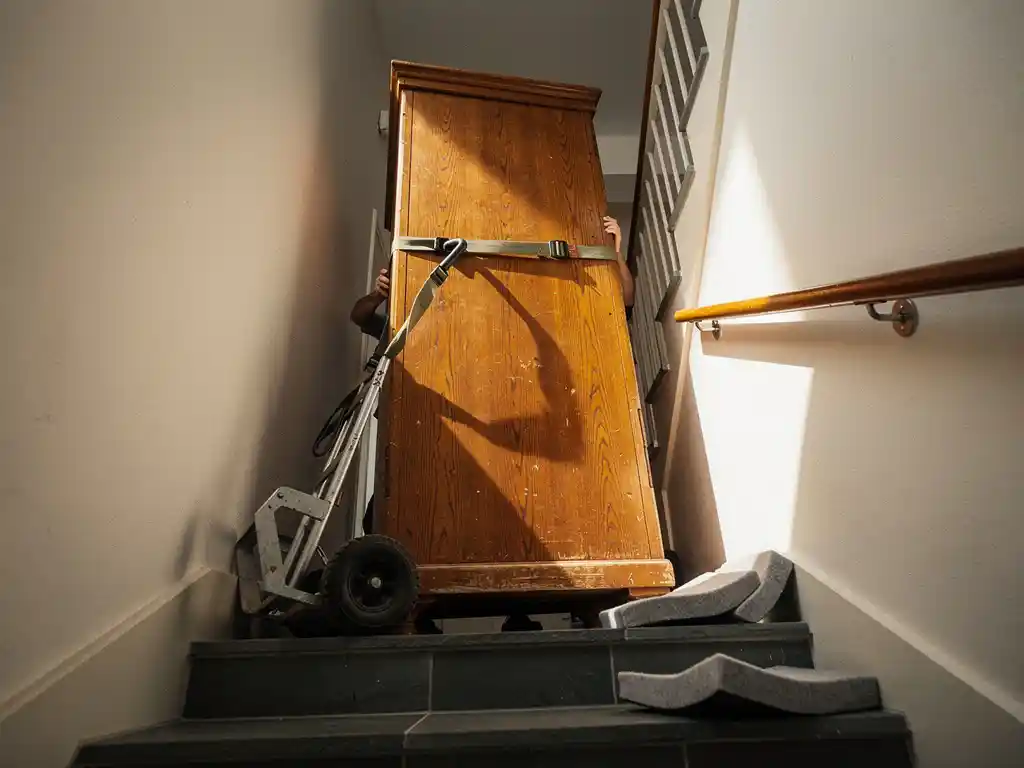
Moving heavy furniture without a lift is entirely possible using the right combination of equipment, technique, and planning. Stair-climbing trolleys, furniture sliders, moving straps, and proper team coordination are the core solutions professionals rely on. The approach that works best depends on the weight of the items, the staircase configuration, and whether you are handling the move yourself or working with trained logistics specialists. Below, we answer the most common questions about liftless furniture moving so you can make informed decisions before, during, and after your move.
What equipment is used to move heavy furniture without a lift?
The most effective equipment for moving heavy furniture without a lift includes stair-climbing trolleys, furniture dollies, moving straps, furniture sliders, and protective blankets. Each tool serves a specific purpose, and using the right combination significantly reduces both physical strain and the risk of damage to furniture or property.
Here is a breakdown of the most commonly used tools:
- Stair-climbing trolleys: Designed with rotating tri-star wheel clusters or motorized treads, these trolleys grip each step and carry heavy loads up or down staircases with controlled movement.
- Furniture dollies: Flat, wheeled platforms ideal for moving bulky items across level floors before and after navigating stairs.
- Moving straps and harnesses: These distribute the weight of a heavy item across the mover’s body, reducing back strain and improving control on stairs.
- Furniture sliders: Placed under the legs or base of furniture, sliders allow heavy pieces to glide smoothly across hard floors or carpets without scratching surfaces.
- Protective blankets and corner guards: Essential for preventing scratches, dents, and scuffs on both the furniture and the walls during transit.
Professional movers typically combine several of these tools depending on the specific challenge. A wardrobe being moved to a third-floor apartment, for example, might require a stair-climbing trolley for the stairs, furniture sliders across the landing, and moving straps for two-person carries through narrow doorways.
How do professional movers handle heavy furniture on staircases?
Professional movers handle heavy furniture on staircases through a combination of proper equipment, coordinated teamwork, and pre-move planning. Before lifting anything, experienced teams assess the staircase dimensions, the weight of the item, and any tight corners or low ceilings that could create obstacles. This planning stage is what separates professional results from risky improvisation.
In practice, the process typically follows these steps:
- Assessment: Measure doorways, staircase width, ceiling height, and landing space to determine whether the item can be moved whole or needs partial disassembly.
- Disassembly where needed: Legs, drawers, shelves, and doors are removed to reduce both weight and bulk before the move begins.
- Equipment selection: The right trolley or strap system is chosen based on the item’s weight and the staircase configuration.
- Team positioning: One mover guides from below while another steers from above, maintaining constant communication throughout.
- Controlled movement: Heavy items are moved one step at a time, never rushed, with regular pauses to reposition grip and check balance.
For very large or unusually heavy pieces, professional teams may use motorized stair-climbing equipment that mechanically powers the item up each step, removing much of the manual effort and reducing injury risk substantially.
What’s the difference between a stair-climbing trolley and a standard dolly?
The key difference between a stair-climbing trolley and a standard dolly is that a stair-climbing trolley is specifically engineered to navigate steps, while a standard dolly is designed for flat, level surfaces only. Using a standard dolly on stairs is not just ineffective but genuinely dangerous, as the wheels provide no grip or stability on a stepped surface.
A standard furniture dolly has four fixed or swivel wheels arranged at the corners of a flat platform. It excels at rolling heavy items across warehouse floors, hallways, and loading areas but has no mechanism to handle the vertical change of a staircase.
A stair-climbing trolley, by contrast, uses one of two main designs:
- Tri-star wheel clusters: Three wheels arranged in a triangle rotate around a central hub. As the trolley meets a step, the cluster rotates to lift the load onto the next tread, creating a smooth rolling motion up or down the stairs.
- Motorized stair climbers: These use electric-powered rubber tracks or treads that grip each step and propel the load upward with minimal manual effort, ideal for very heavy items or long staircase runs.
For anyone moving heavy furniture in a building without an elevator, investing in or hiring access to a proper stair-climbing trolley is not optional. It is the single most important piece of equipment for safe, efficient stair navigation.
When should you hire a professional logistics service for furniture without a lift?
You should hire a professional logistics service for furniture without a lift when the items are exceptionally heavy or fragile, the staircase is narrow or complex, or the risk of injury or damage outweighs the cost of professional help. In most cases involving large sofas, wardrobes, dining tables, or specialist furniture, professional movers deliver better outcomes at lower total risk.
Consider professional logistics support in these specific situations:
- The item weighs more than two people can safely manage on stairs, even with straps
- The staircase has tight turns, low ceilings, or restricted landings
- The furniture is high-value, antique, or particularly fragile
- The building has multiple floors and no lift access
- The move involves a large volume of heavy items on a tight timeline
- The destination is a commercial space such as an office, hotel, or healthcare facility
For large-scale or complex scenarios, a specialist project logistics service adds particular value. We handle everything from pre-move site surveys and floor plan analysis to on-site coordination and installation, making liftless environments manageable even at significant scale. Our teams have delivered complete furnishing projects in buildings across more than 150 locations worldwide, many of which have presented exactly these kinds of access challenges.
How can furniture be protected from damage during a liftless move?
Furniture can be protected from damage during a liftless move by wrapping items in protective blankets, using corner guards on vulnerable edges, applying furniture sliders to prevent floor scratches, and securing loose parts before any lifting begins. Protection planning should happen before the move starts, not after the first scratch appears.
Here are the most effective protective measures to use throughout a liftless move:
- Moving blankets and stretch wrap: Thick blankets cushion surfaces against wall contact and accidental knocks. Stretch wrap holds blankets in place and keeps drawers and doors from swinging open during the carry.
- Corner and edge protectors: Foam or plastic guards fitted to the sharpest corners of furniture prevent dents and also protect walls and door frames from impact damage.
- Furniture sliders: Placed under the base of heavy items, sliders allow smooth movement across floors without gouging or scratching the surface beneath.
- Disassembly: Removing legs, shelves, and glass panels before the move reduces both the overall size of the item and the number of fragile elements exposed to impact.
- Wall and banister protection: Cardboard sheeting or foam padding taped to staircase walls and banisters prevents scuffs when carrying wide items through tight spaces.
Good protection is as much about preparation as it is about materials. Taking fifteen minutes to properly wrap and secure a piece of furniture before the move begins is far more effective than attempting repairs after the fact. For high-value or specialist furniture, professional packing services provide an additional layer of assurance, using materials and techniques matched specifically to the item being moved.