




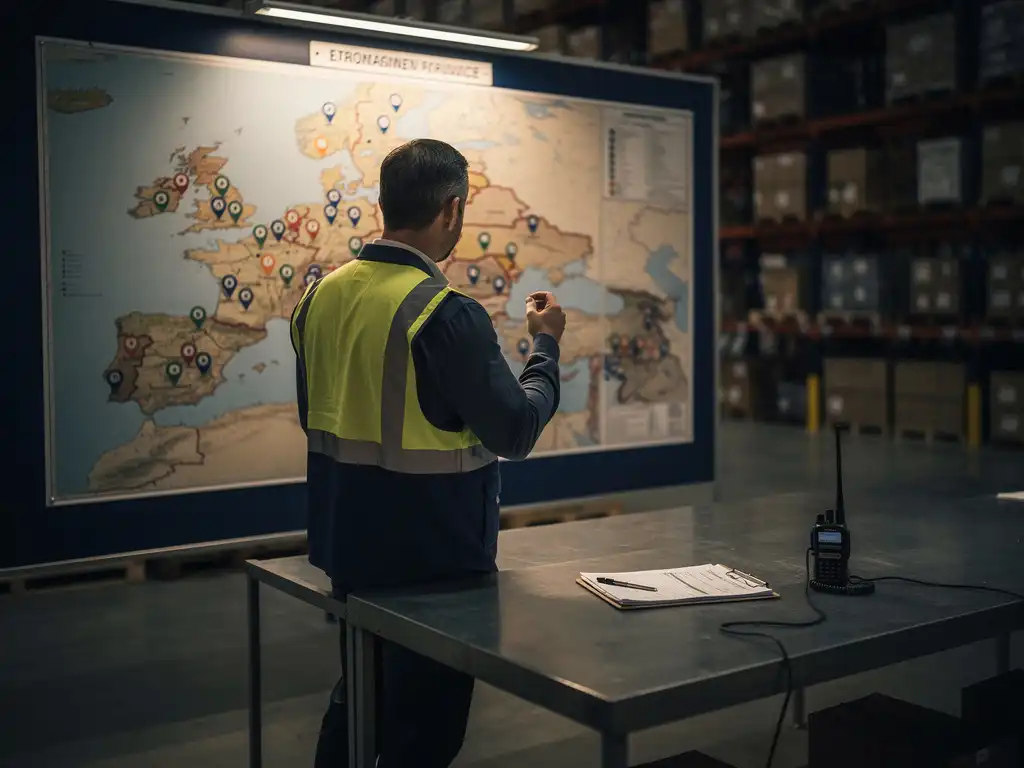
The best way to maintain an inventory of critical infrastructure across locations is to combine a centralised data platform with real-time asset tracking tools and clearly defined data standards that every site follows. Without a single source of truth, teams end up working from outdated spreadsheets, siloed systems, and incomplete records that make coordinated decision-making nearly impossible. The sections below break down each dimension of the challenge, from the tools available to the question of whether to build your own system or work with a logistics partner.
What makes multi-site infrastructure so hard to track?
Multi-site infrastructure is difficult to track because each location tends to generate its own records, use its own naming conventions, and operate on its own schedule. When there is no shared standard, data from site A cannot be meaningfully compared to data from site B, and the inventory of critical infrastructure across locations quickly becomes fragmented and unreliable.
Several factors compound the problem. Physical assets move between sites without always being logged. Different teams use different tools, from basic spreadsheets to purpose-built software, which creates version conflicts and data gaps. Sites in different countries may use different units, currencies, or classification systems, making consolidation a manual, error-prone task.
There is also a human dimension. When ownership of infrastructure data is unclear, no one takes full responsibility for keeping records current. Assets are added, relocated, or retired without updates being made centrally. Over time, even a well-intentioned tracking system drifts away from operational reality. The result is that managers making decisions about maintenance, procurement, or logistics are working from information they cannot fully trust.
What tools are used to track infrastructure across sites?
The most widely used tools for tracking infrastructure across multiple sites fall into four categories: asset management software, IoT-enabled sensors, barcode and RFID systems, and cloud-based logistics platforms. The right combination depends on the type of assets involved, the number of locations, and how frequently assets move.
- Asset management software: Platforms such as enterprise resource planning systems or dedicated fixed asset tools provide a centralised register of all infrastructure items, including location, condition, and maintenance history.
- IoT sensors and GPS trackers: These attach to physical assets and transmit real-time location and status data. They are particularly useful for mobile infrastructure, such as vehicles, containers, or equipment that moves between sites.
- Barcode and RFID systems: These are cost-effective for high-volume, lower-value assets. Staff scan items at intake and transfer points, creating a reliable audit trail without continuous monitoring.
- Cloud-based logistics platforms: These integrate data from multiple sources and make it accessible to teams across locations simultaneously, eliminating the version-control problems that come with locally stored files.
No single tool solves every challenge. Most organisations benefit from layering these approaches: a cloud platform as the backbone, RFID or barcoding for item-level tracking, and IoT sensors for high-value or mobile assets. The key is ensuring that all tools feed into one central record rather than creating additional silos.
How does a logistics control tower improve multi-site visibility?
A logistics control tower improves multi-site visibility by providing a single, real-time overview of all assets, shipments, and infrastructure status across every location. Instead of requiring managers to query each site separately, a control tower aggregates data automatically and surfaces exceptions, delays, or gaps that need attention.
In practice, a control tower functions as a command layer sitting above the individual systems used at each site. It pulls data from warehouse management systems, transport management platforms, IoT feeds, and manual inputs, then presents a unified dashboard. Teams can see at a glance which assets are in transit, which are stationary, and which have not been accounted for recently.
For organisations managing an inventory of critical infrastructure across locations in multiple countries, this visibility has direct operational value. Maintenance can be scheduled proactively rather than reactively. Stock levels can be balanced across sites without over-ordering. And when something goes wrong, the control tower makes it faster to identify where the problem originated and which other sites might be affected.
We apply this kind of integrated oversight in our own project logistics operations, coordinating assets and teams across more than 150 locations worldwide. The discipline of maintaining real-time visibility at that scale reinforces how essential a centralised control layer is when infrastructure spans multiple sites and time zones.
What’s the difference between asset tracking and infrastructure tracking?
Asset tracking monitors the location, condition, and movement of individual physical items, such as a vehicle, a server, or a piece of equipment. Infrastructure tracking is broader: it covers the systems, facilities, and networks that enable operations across sites, including power supply, connectivity, storage capacity, and physical space. The two overlap but serve different purposes.
Asset tracking answers the question: where is this specific item, and what is its current status? It is transactional and item-level, typically updated each time an asset moves or changes hands.
Infrastructure tracking answers the question: is each site operationally capable? It looks at whether the underlying systems that support work are functioning, adequately resourced, and correctly configured. This includes things that are not individual movable items, such as warehouse racking, loading bay capacity, network bandwidth, or utility connections.
For a complete inventory of critical infrastructure across locations, you need both. Asset tracking tells you what you have and where it is. Infrastructure tracking tells you whether each location has what it needs to function. Treating them as the same thing leads to blind spots: you might know exactly where every server is, but not know that a site’s cooling infrastructure is approaching capacity.
Should you build an in-house tracking system or use a logistics partner?
You should build an in-house tracking system if your infrastructure is highly specialised, your data governance requirements are strict, and you have the internal technical resources to build and maintain the system over time. In most other cases, working with an experienced logistics partner delivers faster results, lower ongoing costs, and access to proven tools without the development risk.
Building in-house gives you full control over data architecture, integration choices, and feature development. But it also means absorbing the cost of software development, staff training, ongoing maintenance, and system upgrades. For organisations whose core business is not logistics or technology, this investment rarely pays off compared to the alternatives.
A logistics partner brings established platforms, operational experience, and a network that already spans multiple sites and modalities. Rather than spending months building a system, you gain immediate access to infrastructure that has been tested at scale. The trade-off is less customisation and some dependency on the partner’s roadmap and pricing.
A hybrid approach works well for many organisations: use a partner’s platform for transport, warehousing, and cross-site coordination, while maintaining internal records for site-specific or sensitive infrastructure data. Our warehousing solutions and contract logistics services are designed precisely for clients who want the benefits of a full-service partner without giving up visibility into their own operations.
How do you standardise infrastructure data across different sites?
Standardising infrastructure data across different sites requires three things: a shared taxonomy that all sites use to classify assets and infrastructure, a single platform where all data is recorded and updated, and a governance process that assigns clear ownership for data quality at each location.
Start with the taxonomy. Every site needs to use the same names, categories, and codes for the same types of infrastructure. If one site calls a storage unit a “rack” and another calls it a “shelf bay,” automated consolidation becomes unreliable. A shared master list of terms, agreed upon before any data is migrated, prevents most classification conflicts.
Next, enforce a single system of record. Data that lives in multiple places will always diverge. Whether you use an enterprise platform, a logistics management system, or a purpose-built tool, the rule must be that all updates happen in one place. Local spreadsheets can exist as working documents, but they must never become the authoritative source.
Finally, assign data ownership. Each site should have a named person responsible for keeping infrastructure records current. That person needs clear guidelines on what to record, when to update it, and how to flag discrepancies. Without individual accountability, even the best system degrades over time as operational pressures push data maintenance down the priority list.
For organisations operating across borders, standardisation also means accounting for language, currency, and regulatory differences. Building these variables into the taxonomy from the start, rather than treating them as exceptions, saves significant rework later. If you want to see how this kind of structured approach applies in practice, our client cases illustrate how we manage complex, multi-site logistics with consistent data and clear accountability at every level.