




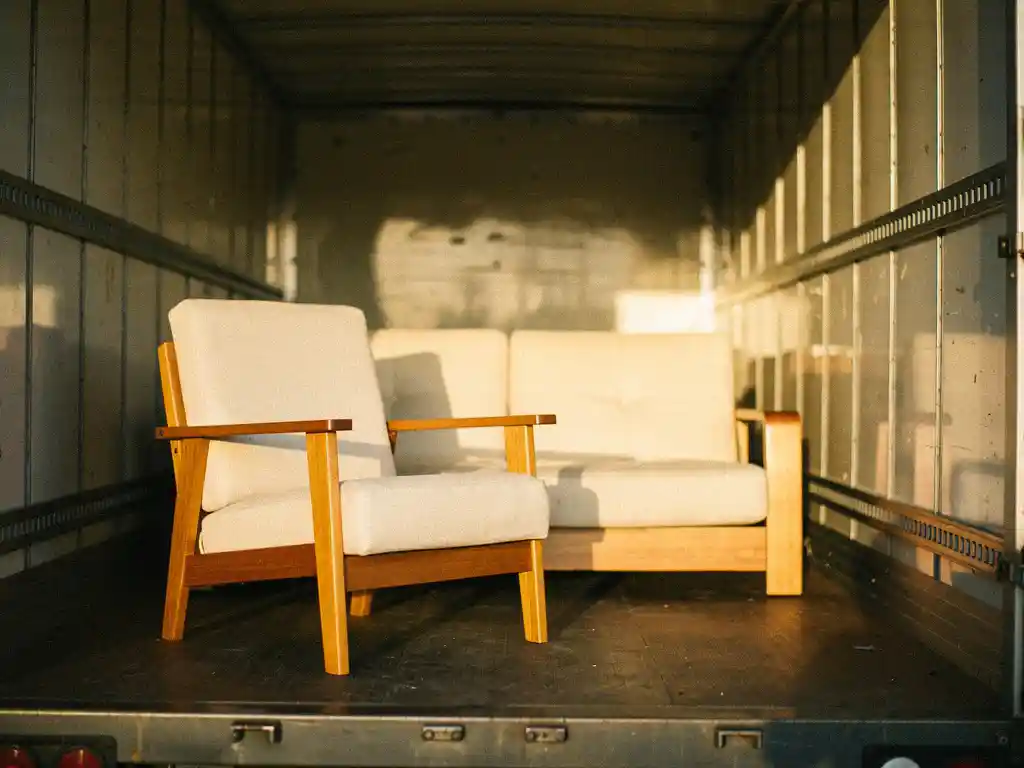
LTL (less than truckload) furniture transport is the smartest choice when your shipment does not fill an entire truck and you want to pay only for the space you actually use. It works best for small to mid-sized furniture orders, sample deliveries, or replenishment shipments where cost efficiency matters more than exclusive transit speed. The sections below explain exactly when LTL makes sense, how it is priced, and when you should consider switching to a full truckload instead.
What types of furniture shipments are best suited for LTL?
LTL furniture transport suits shipments that occupy roughly one to six pallet positions and weigh less than what would justify booking a full trailer. In practical terms, this means single-room deliveries, showroom restocks, prototype or sample pieces, and smaller B2B orders to retail clients or project sites. If your furniture freight does not fill at least half a standard trailer, LTL is almost always the more economical option.
Beyond size, the nature of the goods matters too. Flat-pack furniture travels well in LTL because it stacks efficiently and shares space with other cargo without excessive risk. Fully assembled or oversized pieces, such as large sectional sofas or custom cabinetry, require more careful handling and protective packaging when placed alongside other shippers’ goods, but experienced carriers manage this routinely.
LTL also fits well in the following scenarios:
- Replenishment orders to furniture retailers or showrooms that order regularly in smaller volumes
- E-commerce furniture brands fulfilling individual consumer orders across multiple destinations
- Project logistics where furniture arrives in phased deliveries to a construction or fit-out site
- Cross-border shipments where consolidating cargo reduces freight costs significantly
Our furniture transport services are designed to handle exactly these kinds of shipments, combining careful loading practices with a network that consolidates efficiently across European routes.
How does LTL pricing work for furniture transport?
LTL pricing for furniture freight is calculated based on a combination of shipment weight, dimensions (or volumetric weight), the freight class assigned to the goods, the origin and destination lanes, and any accessorial charges for special handling. Because you are sharing trailer space with other shippers, you pay a proportional rate rather than the full cost of a dedicated vehicle.
Freight class is a particularly important factor in less than truckload furniture pricing. Furniture typically falls into higher freight classes because of its density, fragility, and the space it occupies relative to its weight. Carriers use this classification to account for the extra care and loading space that furniture often requires compared to denser, sturdier cargo.
Common cost factors in LTL furniture shipping include:
- Base linehaul rate: The core charge based on weight and distance
- Fuel surcharge: A variable percentage added on top of the base rate
- Liftgate fees: Required when the delivery location does not have a loading dock
- Inside delivery or white-glove charges: When furniture must be carried beyond the threshold or assembled on site
- Residential delivery surcharge: Applied when delivering to a home address rather than a commercial location
Understanding these components upfront helps you compare quotes accurately and avoid surprise charges on your furniture logistics invoices.
What’s the difference between LTL and FTL for furniture deliveries?
The core difference between LTL and FTL (full truckload) for furniture deliveries is exclusivity. With FTL, you book the entire trailer for your shipment alone. With LTL, your furniture shares space with cargo from other shippers, and the carrier consolidates multiple loads into one vehicle. This distinction drives differences in cost, transit time, and handling risk.
Cost and efficiency
FTL is more cost-effective per unit when you have enough volume to fill or nearly fill a trailer. LTL becomes cheaper when your shipment is small because you split the trailer cost with other shippers. The break-even point varies by route and carrier, but as a general rule, once your shipment exceeds roughly 12 to 15 pallet positions, FTL pricing often becomes competitive with or cheaper than LTL rates.
Handling and transit
FTL shipments are loaded once and delivered directly to the destination, which reduces the number of times furniture is touched and lowers the risk of damage. LTL shipments typically pass through one or more consolidation hubs where loads are sorted and reloaded, introducing additional handling touchpoints. For fragile or high-value furniture, this is an important practical consideration when choosing between the two options.
How does LTL affect delivery times for furniture orders?
LTL shipping generally results in longer transit times than FTL because shipments pass through carrier hubs for consolidation and sorting before reaching the final destination. Where a direct FTL move might deliver furniture overnight or within one to two days, an equivalent LTL shipment on the same lane may take two to five days, depending on the carrier’s network and the number of intermediate stops.
For most furniture retailers and B2B buyers, this transit window is entirely acceptable, especially when the cost savings are significant. The key is setting accurate delivery expectations with your customers or project managers at the time of order. LTL carriers typically provide estimated delivery windows, and many offer tracking so you can monitor your furniture freight in transit.
Delivery times can extend further when accessorial services are involved. Scheduling a specific delivery appointment, arranging inside delivery, or coordinating with a project site that has restricted access hours all add time to the process. Building these factors into your planning avoids frustration and keeps furniture projects on schedule.
What are the biggest risks of using LTL for furniture transport?
The biggest risks of LTL furniture transport are damage from additional handling, longer and less predictable transit times, and limited liability coverage relative to the value of the goods. Because LTL shipments are consolidated and deconsolidated at hubs, furniture is loaded and unloaded multiple times, which increases the chance of contact damage, scratches, or breakage compared to a direct FTL move.
Packaging quality plays a significant role in mitigating damage risk. Furniture shipped via LTL should be properly wrapped, cornered, and secured on pallets to withstand the handling at consolidation points. Carriers are not liable for damage that results from inadequate packaging, so investing in proper protective materials is not optional for valuable pieces.
Other risks worth managing include:
- Claims complexity: When damage occurs in a shared load, identifying responsibility can be more complicated than in a dedicated FTL shipment
- Freight class disputes: If your furniture is classified incorrectly, you may face re-billing after delivery
- Delivery window variability: LTL schedules can shift when other shippers’ cargo causes route adjustments
- Limited visibility: Not all LTL carriers offer the same level of real-time tracking that dedicated transport provides
Working with an experienced furniture logistics partner who understands LTL consolidation and applies appropriate handling standards reduces these risks substantially.
When should furniture shippers switch from LTL to FTL?
Furniture shippers should switch from LTL to FTL when their shipment volume consistently fills more than half a trailer, when the goods are too fragile or high-value to tolerate multiple handling touchpoints, or when delivery deadlines are tight enough that direct transit is the only reliable option. At a certain volume threshold, FTL also becomes cheaper per pallet than LTL rates.
A useful way to evaluate the switch is to compare total landed cost rather than just the freight rate. FTL eliminates hub handling, reduces damage claims, and provides a fixed delivery timeline, all of which have real financial value beyond the line-haul rate itself. If your damage claim rate on LTL shipments is climbing, that is a clear signal to reconsider.
Consider switching to FTL when:
- Your regular shipments exceed 12 to 15 pallet positions or around 10,000 kg
- You are shipping assembled, oversized, or premium furniture that cannot tolerate re-handling
- A project deadline requires a guaranteed delivery date that LTL transit variability cannot support
- You are consolidating multiple smaller LTL moves that could be batched into one efficient FTL run
- Your delivery destination requires complex access coordination that benefits from a dedicated driver and vehicle
For large-scale project deliveries, such as furnishing an entire office building or hotel, a dedicated approach through project logistics often makes far more sense than LTL, giving you controlled delivery sequencing and on-site installation support. The right choice always comes down to matching the shipping method to the actual demands of the shipment, and we are happy to help you work through that decision for your specific situation.