




You should hire a project logistics specialist when your project involves complex, multi-phase coordination that goes beyond standard freight movement. This applies to large-scale fit-outs, international installations, time-critical builds, or any situation where a single delay can cascade across an entire project. The sections below walk through the key signals, timing, and selection criteria to help you make the right call.
What does a project logistics specialist actually do?
A project logistics specialist plans, coordinates, and executes the full logistics chain for complex, large-scale projects. Unlike a standard carrier or freight forwarder, they manage every moving part from pre-project planning and warehousing through to on-site assembly, installation, and customs clearance, taking end-to-end ownership of delivery outcomes rather than just individual shipments.
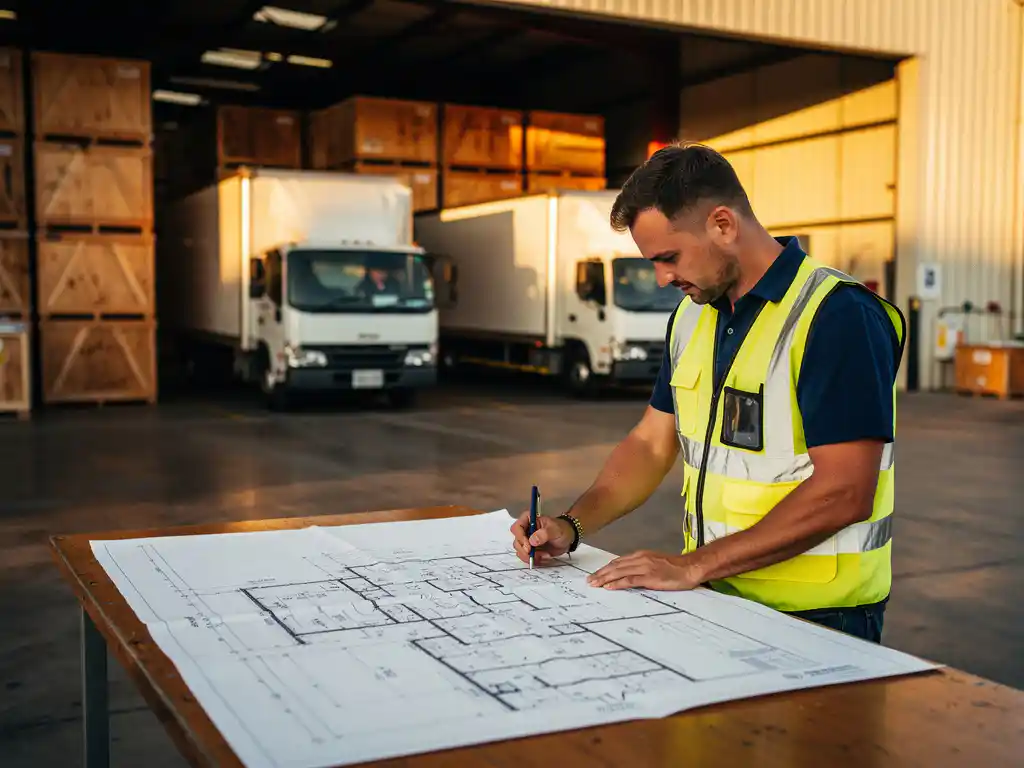
In practice, this means studying floor plans and site access conditions before a single item leaves the warehouse, coordinating multiple subcontractors and local partners across different countries, and building contingency plans for the unexpected. A project logistics specialist is not simply moving goods from A to B. They are engineering a sequence of events that must arrive in the right order, at the right time, and in the right condition.
Our project logistics services cover the full scope: transport, distribution, warehousing, assembly, installation, and customs handling, all managed under one roof. That single point of accountability is what separates specialist project logistics from piecing together multiple providers independently.
What types of projects require specialist logistics support?
Projects that require specialist logistics support are those where timing, sequencing, scale, or access complexity make standard freight arrangements inadequate. This includes large office and workplace fit-outs, hotel and hospitality furnishing projects, school and hospital refurbishments, trade fair and exhibition builds, and any installation project spanning multiple international locations.
Some concrete examples of when specialist support becomes essential:
- Furnishing a multi-floor office tower in a city centre where loading windows are restricted to specific hours
- Fitting out a school or hospital during a short holiday window with zero tolerance for overrun
- Building a complete exhibition stand within a 48-hour setup period
- Coordinating furniture and equipment delivery across 20 or more locations simultaneously
- Transporting fragile, high-value items such as artwork or bespoke installations that require specialist handling
What these scenarios share is that the logistics itself becomes a critical path item. If the logistics fails, the project fails. That level of risk justifies bringing in a specialist rather than relying on a general freight solution.
What are the signs your current logistics setup isn’t enough?
The clearest sign your current logistics setup is not enough is when coordination starts consuming disproportionate internal time and errors begin compounding across deliveries. If your team is spending more energy chasing shipments, resolving sequencing mistakes, or managing multiple providers than they are spending on the project itself, you have outgrown a standard logistics arrangement.
Other warning signs to watch for include:
- Deliveries arriving out of sequence, causing installation delays on site
- No single point of contact accountable for the full delivery chain
- Customs or documentation issues creating unpredictable hold-ups on international projects
- Damage rates rising because standard freight handling is not suited to the items involved
- Last-minute problem-solving becoming the norm rather than the exception
- Inability to scale capacity quickly when project scope expands
These are not just operational inconveniences. Each one represents cost, delay, and reputational risk. A project logistics company is built to absorb this complexity so your team does not have to.
How early in a project should you bring in a logistics specialist?
You should bring in a project logistics specialist during the planning phase, ideally before procurement decisions are finalised. Engaging early allows the logistics provider to influence how goods are sourced, packaged, routed, and staged, which can significantly reduce cost, risk, and on-site complexity before the project even begins.
Late involvement is one of the most common and costliest mistakes in project logistics. When a specialist is brought in only after contracts are signed and delivery dates are set, their ability to optimise the process is severely limited. They inherit constraints rather than help shape them.
Early engagement enables the logistics team to assess site access conditions, map out phased delivery schedules aligned with installation sequences, identify customs or import requirements for international shipments, and pre-position stock in a warehousing facility close to the project site. All of this preparation is far easier and cheaper to do before the clock is running than to resolve under pressure once it is.
What’s the difference between a project logistics specialist and a standard freight forwarder?
The key difference is scope and accountability. A standard freight forwarder arranges the movement of goods between defined points and hands over responsibility at delivery. A project logistics specialist takes ownership of the entire logistics operation within a project, including sequencing, on-site coordination, assembly, installation, and problem resolution throughout the project lifecycle.
What a standard freight forwarder does well
Freight forwarders are highly effective for moving defined consignments through established shipping lanes. They handle documentation, customs brokerage, and carrier booking efficiently. For straightforward import and export needs, they are the right tool. Their strength is transaction-based logistics where the scope is clear and the variables are limited.
Where a project logistics specialist goes further
A project logistics specialist operates more like a project manager with deep logistics expertise. They work from floor plans and project timelines, not just shipping instructions. They coordinate multiple trades, manage on-site delivery windows, arrange local partner networks in cities they may never have visited before, and adapt in real time when conditions change. When you need a complete hotel lobby furnished and operational by a fixed opening date, a freight forwarder can move the furniture. A project logistics specialist makes sure it is in the right room, assembled, and ready.
How do you choose the right project logistics partner?
Choosing the right project logistics partner comes down to three factors: relevant experience with projects of similar scale and type, a proven network that covers your project locations, and a demonstrated ability to manage complexity without losing accountability. A partner with all three gives you both the capability and the confidence to hand over a critical operation.
When evaluating potential partners, look for the following:
- Sector-specific experience: Have they handled projects in your industry, whether that is hospitality, healthcare, retail, or corporate interiors? Familiarity with sector-specific constraints saves significant time.
- Geographic reach: Do they have established local partner networks in the countries or cities where your project is based? Reach matters more than headquarters location.
- End-to-end capability: Can they handle transport, warehousing, customs, assembly, and installation under one roof, or will you be managing gaps between providers?
- Planning rigour: Do they invest in pre-project site analysis, floor plan review, and sequencing before work begins? This is a reliable indicator of operational maturity.
- Responsiveness under pressure: Ask how they handle unexpected changes on site. The answer will tell you a great deal about their culture and capability.
We have been delivering project logistics solutions across more than 150 locations worldwide since 1924, as part of the global Logistics Plus network. If you are assessing whether we are the right fit for your next project, our project cases offer a direct look at the kind of work we take on, and our team is always available to discuss your specific requirements via our contact page.