


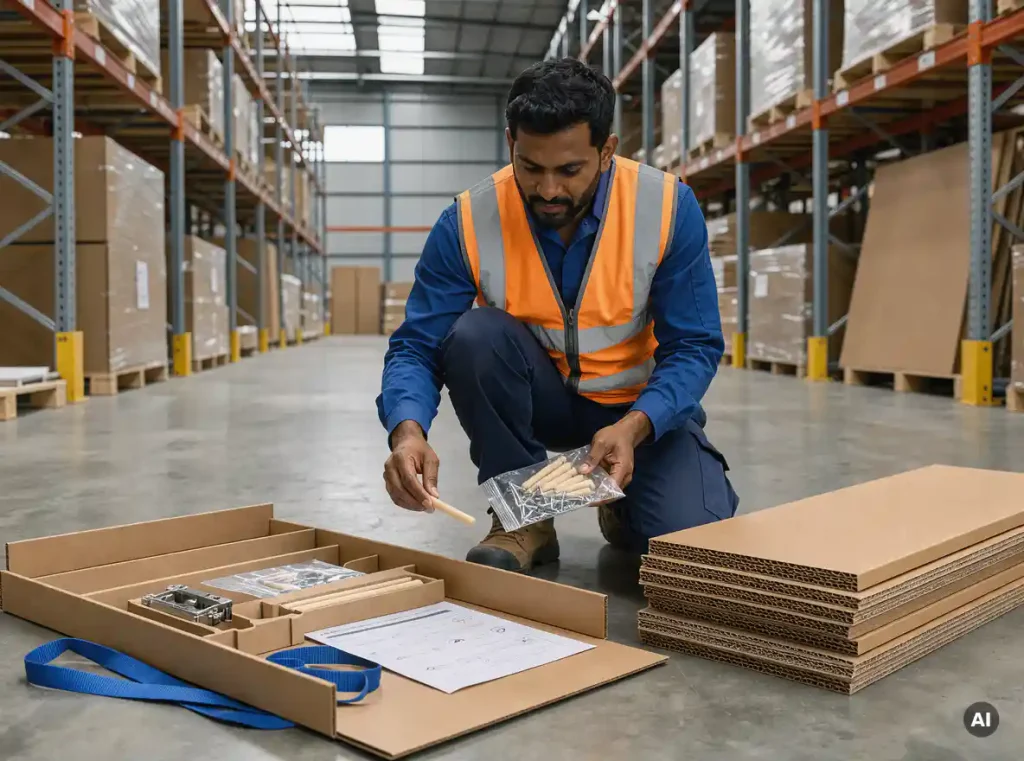
Seven warehouse checks prevent missing furniture parts: inbound inspection, labeled and sealed part kits, a dedicated hardware station, scan-based picking, a pre-wrap completeness check, a final dispatch inspection, and a documented exception process. Each check closes a gap where parts get separated from their set. Together they turn completeness from a hope into a repeatable routine.
Most shortages are not caused by theft or carelessness. They come from small handoffs between receiving, storage, picking and loading. The questions below show where parts disappear and which checks stop them.
Where do furniture parts most often go missing?
Furniture parts most often go missing at four handoff points: at inbound receiving, when hardware is separated from the main item, during picking and repacking, and at loading. Small items such as screws, brackets, feet and instruction sheets are the most vulnerable because they are easy to detach, misplace or leave behind.
Several patterns repeat across furniture warehousing:
- Multi-box sets: A sofa, table or bed frame arrives in several cartons. If one carton is stored separately or picked late, the set ships incomplete.
- Loose hardware: Fittings taped to a panel or placed loose in a carton come off during handling.
- Opened packaging: Every time a carton is opened for inspection or repacking, parts can be left out or swapped.
- Similar-looking items: Near-identical finishes or sizes lead to mismatched components.
Knowing these weak spots tells you where to place your checks. A step that sits right where the risk is does far more than a general inspection at the end.
Which warehouse checks stop furniture parts going missing?
Seven checks work together to stop furniture parts going missing: inbound inspection against the packing list, labeled part kits, a hardware verification station, scan-based picking, a completeness check before wrapping, a final dispatch inspection, and a clear exception process. Each one catches a different type of error at a different stage.
- Inbound inspection: Count cartons and compare them with the delivery note and order. Record any difference before the goods are put away, so the shortage is traced to its source early.
- Kitting furniture parts: Group every component of a set under one reference with matching labels, so all parts travel together instead of being stored as separate lines.
- Hardware verification: Check fittings, screws and tools against the assembly list at a dedicated station, then seal them in a labeled bag attached to the correct item.
- Scan-based picking: Scan each carton or label when it is picked. The system flags a missing piece immediately instead of at the customer’s door.
- Pre-wrap completeness check: Before blankets, film or crates go on, verify the full set against the order. Once wrapped, a missing part is hard to spot.
- Final dispatch inspection: A second person confirms piece counts at loading, matching what is on the truck to the shipping documents.
- Exception handling: Define who is notified, how the issue is logged and how the part is traced, so a flagged shortage never gets lost between shifts.
The most effective setups also train staff in furniture handling specifically. At Jan Krediet, we train our own people in-house, because furniture logistics is a specialized profession and care for the product shapes every check. You can read more about our approach to furniture warehousing.
How do you verify a furniture set is complete?
You verify a furniture set is complete by comparing every component against the order and the manufacturer’s parts list, then confirming the count at two points: before packaging and before loading. Use labels or barcodes to tie each part to one set, and record the result so you have proof of what left the warehouse.
A practical verification routine looks like this:
- Start from the order, not from the pile of boxes in front of you.
- Match each carton label to the set reference and the expected number of packages, such as “3 of 4.”
- Open sealed hardware bags only when the packing list requires it, and reseal with a new label if you do.
- Photograph the set before wrapping where the value or complexity of the product justifies it.
- Have a different person do the final count at dispatch for an independent check.
The “x of y” labeling method is simple and powerful. It lets anyone along the chain see instantly whether a package is missing without consulting a system. For high-end pieces and project orders with many items, this kind of structure is essential. Our project logistics teams apply the same discipline when furnishing complete offices, schools and hotels, where one missing part can hold up an entire installation.
What should happen when a part is found missing?
When a part is found missing, stop the set from shipping, record the shortage with the order reference and photos, search the last known location, and notify the responsible contact immediately. If the part cannot be found quickly, arrange a replacement from the manufacturer and update the customer with a realistic timeline.
A clear sequence keeps the response calm and fast:
- Hold the set: Mark it as incomplete so nobody loads it by mistake.
- Document the gap: Note what is missing, where it was last scanned and who handled it.
- Trace backwards: Check the inbound record, kitting area and returns before assuming the part never arrived.
- Escalate quickly: Inform the customer or manufacturer early, ideally with a proposed solution rather than only a problem.
- Close the loop: Log the cause so the same failure does not recur.
Speed and honesty matter most here. A customer told on day one that a foot is on its way is far more forgiving than one who discovers the gap while the delivery team is already in the living room.
How can you measure whether the checks are working?
You can measure whether the checks work by tracking a few simple numbers over time: the share of orders delivered complete, the number of shortage claims per thousand orders, and the stage where each shortage is first detected. If shortages are falling and are found earlier in the process, the checks are doing their job.
Useful indicators include:
- Complete-delivery rate: Orders delivered with every part, first time.
- Shortage claims: Count and trend, split by product type and customer.
- Detection point: Whether gaps are caught at inbound, before wrapping, at dispatch, or only by the end customer. Earlier is better.
- Time to resolve: How long it takes to trace or replace a missing part.
- Root causes: A recurring list of reasons, such as supplier shortfall, picking error or damaged packaging.
Review these figures regularly with the team rather than only in reports. When staff see which checks catch the most problems, they trust the routine and follow it more consistently. If you want to talk through a setup that fits your products, you can get in touch with our team, and we will gladly think along.