




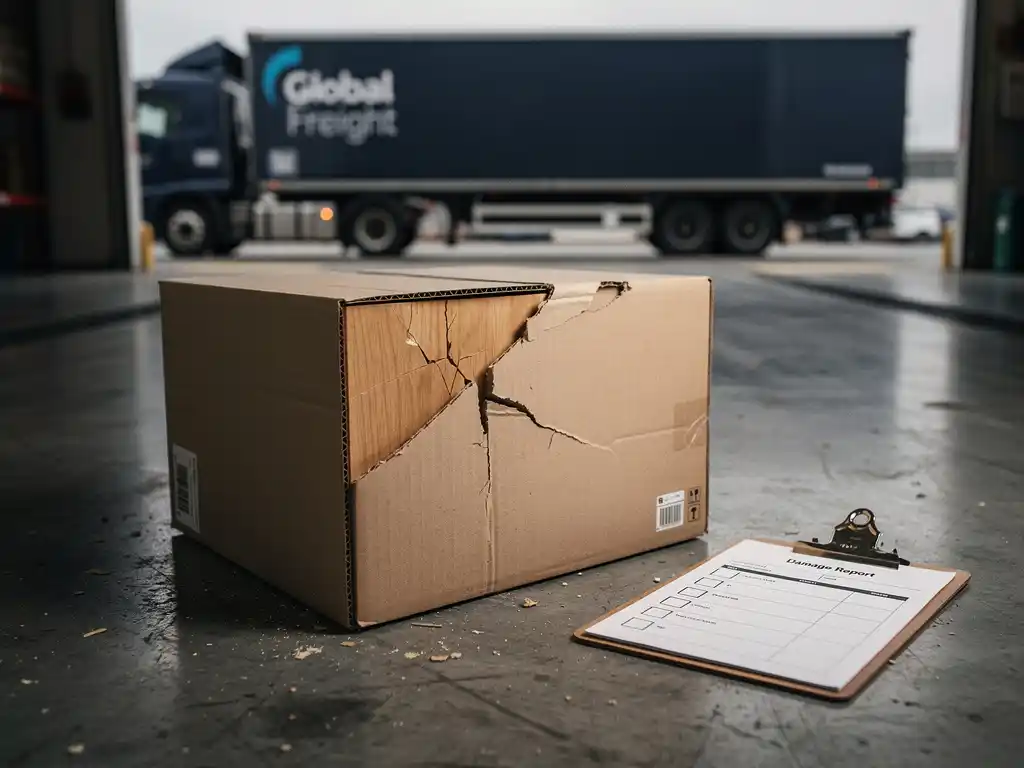
In project logistics, responsibility for damage is shared across multiple parties depending on where in the supply chain the damage occurred, what contractual agreements are in place, and whether cargo insurance applies. The carrier is typically liable for damage during transit, the freight forwarder may bear responsibility for coordination failures, and the shipper can be held accountable for inadequate packaging or documentation. Understanding exactly who owes what requires looking at each party’s role, the applicable transport law, and the evidence available at the time of the claim.
Who is legally liable when goods are damaged during transport?
The carrier is legally liable for damage that occurs during transport, provided the goods were in good condition when handed over and the damage is not attributable to an excluded cause. Most international transport is governed by specific conventions — CMR for road freight, the Montreal Convention for air, and the Hague-Visby Rules for sea — each of which sets limits on the carrier’s financial liability per kilogram or unit of value.
These liability limits are often significantly lower than the actual commercial value of the goods, which is why relying solely on statutory carrier liability rarely makes a shipper whole after a serious loss. Carriers can also invoke exclusions such as inherent vice of the goods, insufficient packaging by the shipper, or force majeure events. For high-value or complex project logistics shipments, this makes it essential to understand the applicable legal framework before a claim ever arises.
What role does the freight forwarder play in a damage claim?
A freight forwarder is responsible for organising and coordinating the transport on behalf of the shipper, but is not automatically liable for physical damage to goods unless the forwarder also acted as the actual carrier. The forwarder’s liability typically arises in cases of negligent coordination, failure to instruct carriers correctly, or errors in documentation that contributed to the damage or complicated the claim.
In practice, the freight forwarder often acts as the first point of contact when damage is discovered. A competent forwarder will gather evidence, notify the carrier on the shipper’s behalf, and help manage the claims process. Their contractual terms, typically based on national forwarding conditions, will define the scope of their own liability. It is worth reviewing those terms carefully, particularly for complex projects involving multiple sub-contractors or cross-border movements where coordination risk is higher.
When is the client or shipper responsible for logistics damage?
The shipper bears responsibility for damage when the cause can be traced back to their own actions or omissions. The most common examples are inadequate packaging, incorrect labelling, inaccurate weight or dimension declarations, and failure to communicate special handling requirements. If a carrier can demonstrate that the damage resulted from any of these factors, their own liability is reduced or eliminated entirely.
In project logistics specifically, where goods are often bespoke, oversized, or fragile, the shipper’s obligation to prepare cargo correctly is particularly significant. Furniture, fitted kitchens, and custom interior components require packaging that accounts for the stresses of loading, stacking, and multi-leg transport. When a shipper hands over goods without adequate protection or without flagging special requirements, they carry a meaningful share of the risk if something goes wrong.
How does cargo insurance affect who pays for damage?
Cargo insurance does not change who is legally liable for damage, but it does determine who actually pays in practice. When a shipper holds all-risk cargo insurance, the insurer compensates the shipper for the loss and then exercises the right of subrogation to recover costs from the liable party. This means the shipper is made whole quickly without needing to pursue the carrier or forwarder directly, which can be a lengthy process.
Without cargo insurance, the shipper is limited to recovering from the carrier under the applicable transport convention, subject to the liability caps mentioned earlier. For high-value goods, those caps often fall well short of the actual loss. Cargo insurance bridges that gap and also covers situations where liability is genuinely unclear or disputed. For anyone involved in large-scale project work, whether fitting out a hotel, a hospital, or a corporate office across borders, adequate cargo cover is a practical necessity rather than an optional extra.
How should damage in project logistics be reported and documented?
Damage in project logistics must be reported to the carrier as soon as it is discovered, and ideally noted on the delivery receipt at the moment of handover. For visible damage, a written reservation on the delivery document is essential. For concealed damage, most transport conventions require written notice within seven days of delivery. Missing these deadlines can significantly weaken or invalidate a claim.
Thorough documentation is the foundation of any successful freight damage claim. The steps to follow are:
- Note the damage on the delivery receipt before signing, describing it specifically rather than using general terms
- Photograph the damaged goods, the packaging, and any relevant markings before anything is moved or unpacked further
- Retain all original packaging for inspection by the carrier or insurer
- Send written notification to the carrier and freight forwarder without delay
- Obtain a surveyor’s report for high-value losses, as this provides independent evidence of the cause and extent of damage
- Keep records of all costs incurred as a result of the damage, including replacement, reinstallation, or project delays
In project logistics, where deliveries often take place at active construction or installation sites, having a clear on-site protocol for checking and recording deliveries is one of the most effective ways to protect against disputed claims later.
What happens when multiple parties share responsibility for damage?
When damage in project logistics involves more than one responsible party, liability is apportioned based on each party’s contribution to the loss. A court or arbitrator will examine the contractual chain, the sequence of events, and the evidence to determine what percentage of fault belongs to each party. In practice, this can involve the carrier, the freight forwarder, a sub-contractor, and the shipper simultaneously.
Shared responsibility situations arise frequently in complex projects. For example, if a shipper provided inadequate packaging and the carrier also handled the goods carelessly, both parties contributed to the outcome. In such cases, each party’s insurer may be involved, and the resolution can take considerable time. Clear contracts, well-defined responsibilities at each handover point, and meticulous documentation at every stage of the logistics chain are the most effective tools for limiting exposure when things go wrong.
Working with an experienced logistics partner who manages the full chain, from warehousing and transport through to on-site installation, reduces the number of handover points where responsibility can become unclear. Fewer parties in the chain means fewer disputes when damage occurs. If you want to understand how we structure accountability across complex projects, our team is happy to walk you through our approach. Feel free to get in touch directly.