


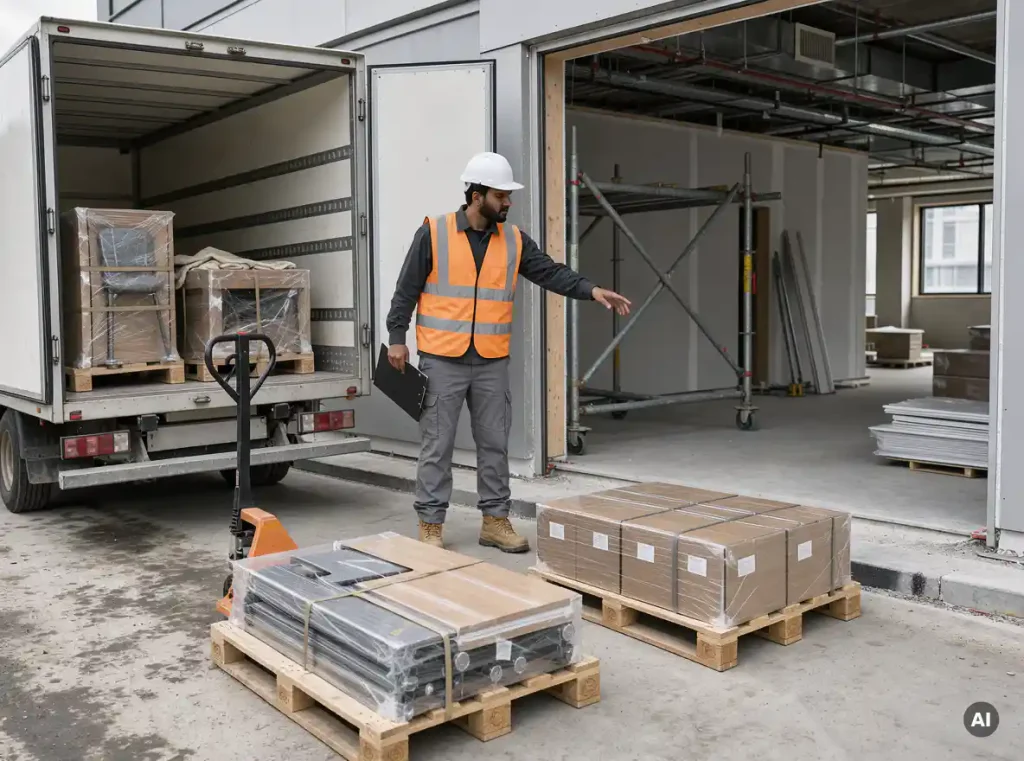
On a fit-out project, the main contractor or a dedicated site logistics manager should own deliveries, not each individual trade. One coordinated owner books slots, sequences arrivals and controls site access, so furniture, kitchens and installation crews arrive in the right order. This article covers who holds that role, how to schedule, and when to hand it over.
Multiple fit-out contractors working in the same building quickly create competing delivery needs. A single point of control keeps the site safe, the schedule intact and the end result on time. We have supported project teams in exactly this situation for many years, and the patterns are consistent.
Who is responsible for site logistics on a fit-out project?
The main contractor is normally responsible for site logistics, often through a site logistics manager or site manager who controls access, unloading areas, lifts and delivery slots. When furniture, kitchens or technical equipment are involved, this role can be delegated to a specialist logistics partner with a clear mandate.
Responsibility has to be written down early. In practice, a few parties are involved:
- Main contractor: sets the master programme, site rules and access times.
- Site logistics manager: approves and sequences delivery bookings for all trades.
- Individual fit-out contractors: submit their delivery needs in advance and follow the agreed slots.
- Logistics partner: handles transport, storage and installation deliveries for specific packages, such as furniture or equipment.
The key is that one person or organisation has the final say. Without that, every contractor optimises for their own timeline, and the site pays the price.
How do you schedule deliveries for multiple contractors?
Schedule deliveries by working backwards from the installation programme. Collect every contractor’s requirements, assign fixed delivery slots through one shared booking system, and sequence arrivals so that each trade finishes before the next one needs the space. Review the schedule weekly and adjust it as the programme shifts.
A practical delivery scheduling process on a construction site looks like this:
- Map the programme. Identify which trades work in which zones and when each zone must be ready for the next phase.
- Collect delivery requests. Ask each contractor for volumes, vehicle types, handling needs and preferred dates.
- Assign slots. Allocate time windows per vehicle, considering lift capacity, loading bay space and noise restrictions.
- Confirm and communicate. Share the plan with all parties, including drivers, so everyone knows the rules on arrival.
- Review and adapt. Hold a short weekly check, because fit-out schedules rarely stay static.
Furniture installation logistics deserves special care. Premium furniture should arrive only once dust-generating work is complete, and it needs protected routes through the building. For this kind of work, our project logistics team plans delivery and installation as one connected process.
What problems occur when contractors manage deliveries separately?
When contractors manage deliveries separately, the most common problems are congested loading areas, clashing arrival times, damaged goods, blocked lifts and idle crews waiting for materials. Each contractor optimises for themselves, so the site as a whole loses time, money and control over safety.
The typical issues include:
- Queues and double bookings: several trucks arrive at the same unloading point at once.
- Storage chaos: goods are dropped wherever space is available, then moved repeatedly, which raises the risk of damage.
- Early or late arrivals: materials show up before the area is ready, or crews wait for items that were never booked.
- Unclear accountability: when something goes missing or breaks, nobody owns the problem.
- Extra traffic: more vehicle movements mean more cost, more emissions and more disruption to neighbours or other tenants.
These problems compound. A single missed delivery can delay a trade, which delays the next one, and the knock-on effect often reaches the handover date.
Should deliveries go through a central consolidation point?
Yes, for most multi-contractor fit-outs a central consolidation point is the better approach. Goods are received, checked and stored off site, then delivered to the building in controlled batches that match the installation sequence. This reduces vehicle movements, protects goods and keeps the site clear.
The benefits are practical and measurable on site:
- Fewer trucks at the building: goods arrive in planned loads rather than as many separate shipments.
- Quality control: items can be inspected, counted and, where needed, pre-assembled before they reach the site.
- Flexibility: if the programme slips, goods wait safely in the warehouse instead of cluttering the building.
- Just-in-time delivery: installers receive exactly what they need, when they need it.
A consolidation hub works best when it is connected to professional warehousing and storage, so goods are handled by people who understand fragile and high-value interiors. It also supports sustainability goals, since fewer, fuller loads mean fewer kilometres driven.
When should a logistics partner take over delivery management?
A logistics partner should take over delivery management when a project involves many contractors, tight deadlines, high-value or fragile goods, multiple locations, or international shipments. If your team spends more time chasing deliveries than managing the build, it is time to hand the coordination to a specialist.
Typical signs that a partner adds value:
- Five or more suppliers or contractors deliver to the same site.
- Goods arrive from different countries and need customs handling.
- Furniture, kitchens or technical equipment must be installed, not just dropped off.
- The site has limited access, such as a high-rise building with restricted lift time.
- You are running several fit-outs at the same time, for example across a hotel group or office roll-out.
A single logistics partner gives you one contact person, one plan and one point of accountability from receipt to final installation. We cover transport, warehousing, assembly, installation and customs under one roof, and our project teams have completed installations at more than 150 locations worldwide. You can explore examples in our project cases.
If you are planning a fit-out and want to simplify delivery coordination, get in touch with our team to talk through your project.