


Professional assembly of high-tech equipment is carried out by logistics and installation specialists who combine technical knowledge, careful handling procedures, and project coordination skills to configure complex equipment correctly at its destination. The right provider handles everything from transport and unpacking through to final connection and testing, ensuring the equipment is fully operational when they leave. Below, we answer the most important questions to help you identify what to look for and how to choose the right partner.
What does professional assembly of high-tech equipment include?
Professional assembly of high-tech equipment includes the complete process of receiving, positioning, assembling, connecting, and verifying complex technical equipment at its final location. It goes well beyond basic installation, covering careful unpacking, component-level assembly, cable management, system integration, and a final functional check before handover to the client.
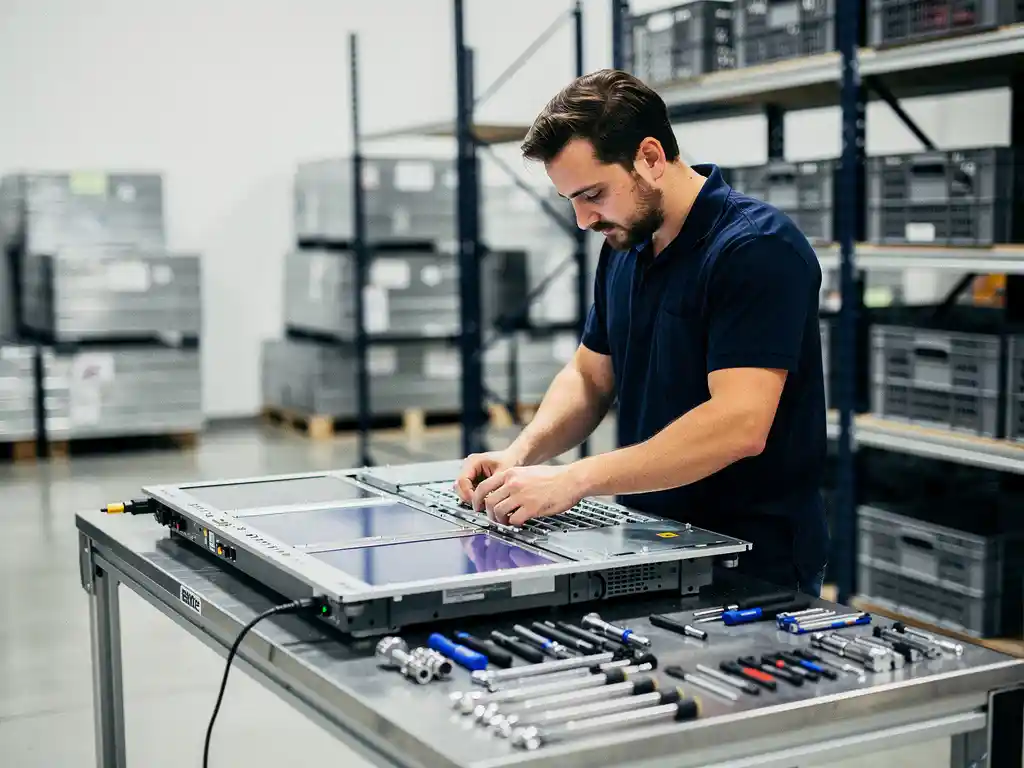
Depending on the equipment type and environment, the process may also include working in controlled conditions. Server cabinets, for example, require assembly in a dust-free environment to protect sensitive components. At Jan Krediet, we assemble server cabinets in a dedicated clean room within our warehouse, which protects hardware integrity throughout the build process. After assembly, we manage warehousing, refurbishment, and worldwide distribution of the finished units.
Other elements that fall within professional high-tech assembly services include:
- Pre-delivery inspection and quality checks
- Coordination with building or facility managers on access and timing
- Positioning of equipment in the correct room or rack location
- Connection of power, data, and network infrastructure
- Configuration and basic testing before handover
- Removal and responsible disposal of packaging materials
The scope varies by project, but a professional provider will define the full service clearly in advance and take ownership of every step from first delivery to final sign-off.
Which industries rely on high-tech equipment assembly services?
Several industries depend on professional assembly of high-tech equipment, particularly those where incorrect installation carries significant operational or financial risk. The most prominent sectors include information technology, healthcare, financial services, education, and the workspace and coworking sector.
In the IT sector, businesses outsource server cabinet assembly and data centre fit-outs to specialists who can work in controlled environments and meet strict technical standards. Healthcare organisations require precise installation of diagnostic and monitoring equipment where accuracy is non-negotiable. Financial services firms need secure, traceable deployment of workstation and infrastructure equipment, often across multiple locations simultaneously.
Large organisations also use professional assembly services to equip employees working from home, deploying furniture, monitors, and connected devices on a turnkey basis. This model, which we support through our contract logistics service, means the client hands over full responsibility and the end user receives everything fully assembled and connected.
The education and coworking sectors round out the list, with schools and flexible office providers regularly commissioning large-scale fit-outs that include both furniture and technology. Our project logistics team has completed installations at more than 150 locations worldwide, covering cities from Berlin to Cape Town and Paris.
What qualifications should a professional assembly provider have?
A professional assembly provider for high-tech equipment should hold relevant certifications, employ trained and experienced technicians, demonstrate a track record with comparable projects, and operate with clear quality and accountability standards. Certifications such as ISO 14001 for environmental management signal that the provider operates to internationally recognised standards across its entire operation.
Beyond formal credentials, the quality of in-house training matters enormously. Providers who train their own staff rather than relying entirely on external contractors maintain consistent standards and build institutional knowledge about specific product types and client requirements. At Jan Krediet, we train our own personnel through our internal JK Academy, combining on-the-job experience with structured professional development.
Key qualifications to look for when evaluating a provider include:
- Technical competence: Demonstrated ability to handle the specific equipment category, including controlled environments where required
- Project management capability: Dedicated project managers who oversee planning, coordination, and execution from start to finish
- Logistics infrastructure: Warehousing, transport, and customs capabilities that support the full supply chain, not just the final assembly step
- International reach: A partner network that can deliver and assemble equipment at locations worldwide, not only domestically
- Accountability structures: A single point of contact and clear escalation procedures throughout the project
You can learn more about the standards we apply across our operations on our standards page.
How does logistics expertise improve high-tech equipment assembly?
Logistics expertise improves high-tech equipment assembly by ensuring that the right components arrive at the right location in perfect condition, at exactly the right time. Without strong logistics management upstream, even the most skilled assembly team cannot perform effectively if deliveries are late, damaged, or incomplete.
The connection between logistics and assembly quality is direct. Equipment that is transported without appropriate protection, stored in unsuitable conditions, or delivered without a coordinated plan risks arriving in a state that compromises the entire assembly process. A logistics-led approach integrates transport, warehousing, and assembly into a single managed workflow, eliminating the gaps where problems typically occur.
Specific ways logistics expertise adds value to assembly operations include:
- Just-in-time delivery: Equipment arrives when the assembly team is ready, reducing on-site storage requirements and the risk of damage between delivery and installation
- Pre-assembly in the warehouse: Complex configurations can be partially assembled before departure, reducing on-site time and complexity
- Route and load optimisation: Smart planning minimises transit time and handling frequency, both of which reduce the chance of damage to sensitive components
- Customs and documentation management: For international projects, a logistics partner who handles customs clearance prevents delays that would otherwise stall the assembly schedule
Our warehousing operations, including our dedicated clean room facility, are designed specifically to support this integrated model, where logistics and assembly are managed as a single, coordinated service rather than two separate activities.
What’s the difference between standard installation and project logistics assembly?
Standard installation typically refers to a single-location, straightforward setup of equipment by a technician following a defined procedure. Project logistics assembly, by contrast, involves coordinating the delivery, assembly, and installation of equipment across multiple locations, stakeholders, and timelines, with a dedicated project team managing every phase from planning through to final handover.
The distinction becomes meaningful when the scope of work involves complexity. A single server rack installation at one office is a standard installation task. Equipping 150 coworking locations across three continents, each requiring furniture, technology, and finishing elements to be delivered and installed to a consistent standard within a tight programme, is a project logistics challenge.
What standard installation covers
Standard installation is typically reactive and task-focused. A technician arrives, follows a specification, installs the equipment, and leaves. The client manages the surrounding logistics independently, including ordering, delivery coordination, and access arrangements. This model works well for simple, low-volume, single-site deployments where the variables are limited and predictable.
What project logistics assembly covers
Project logistics assembly is proactive and end-to-end. A dedicated project manager coordinates all parties, manages the supply chain, schedules deliveries to match installation windows, and takes responsibility for the outcome at every location. The project team handles complexity on behalf of the client, including unexpected changes to access, sequence, or scope. For large or international deployments, this level of coordination is not optional. It is the difference between a project that completes on time and one that stalls at every obstacle.
How do you choose the right partner for high-tech equipment assembly?
Choosing the right partner for the professional assembly of high-tech equipment comes down to three core criteria: proven experience with comparable projects, integrated logistics and assembly capability under one roof, and a clear accountability structure with a single point of contact throughout the engagement.
Start by reviewing the provider’s case history. A credible partner will be able to point to specific projects in your sector or with similar equipment types, and describe the challenges they navigated and the outcomes they delivered. Generic claims of capability are far less useful than concrete examples.
Next, assess whether the provider controls the full chain. A partner who only handles the final assembly step but outsources transport and warehousing to unrelated parties introduces coordination risk. Look for a provider who owns or closely manages every stage, from goods reception through to final installation and sign-off.
Finally, evaluate the human dimension. Who will manage your project day to day? Is there a named project manager with authority and experience? Can you reach them directly? A strong team behind the service is often the most reliable indicator of consistent execution, especially on complex or international deployments.
We have been building that kind of team since 1924. You can read about the people behind our operations on our team page, or get in touch directly to discuss your project requirements.