




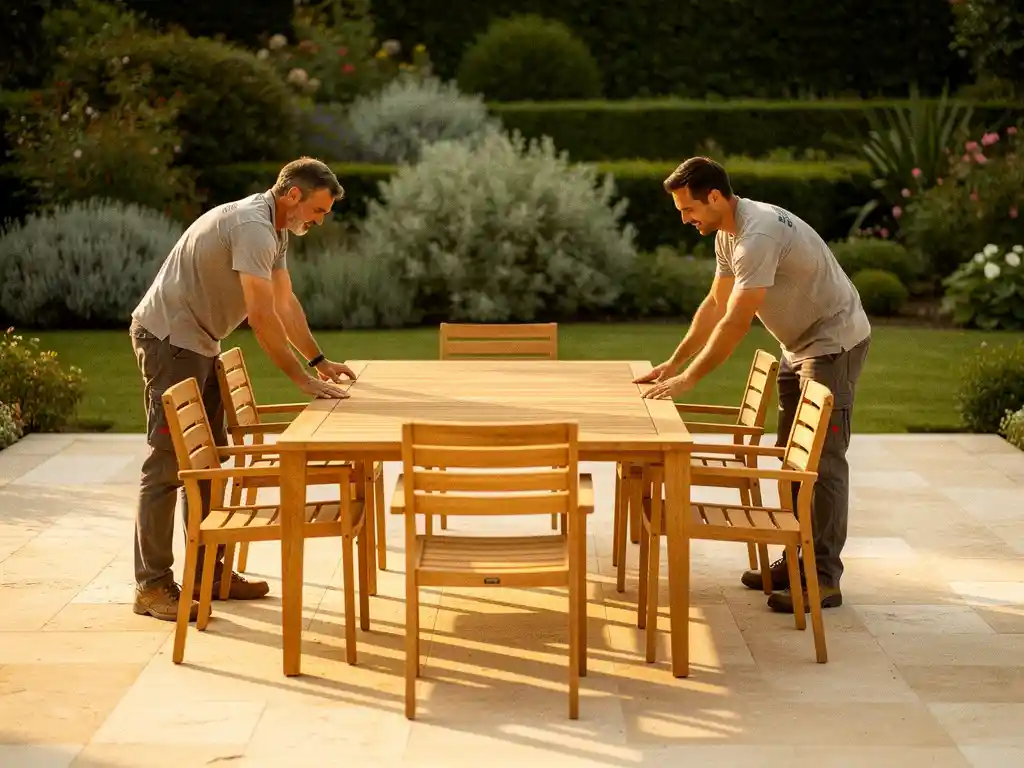
Customers expect turnkey placement for outdoor furniture because they want the product experience to be complete from the moment of delivery. Receiving bulky, heavy, or complex outdoor pieces and being expected to handle final positioning, assembly, or installation themselves creates friction that modern buyers are no longer willing to accept. This article unpacks exactly what that expectation involves, where it comes from, and how logistics providers can meet it reliably.
What does turnkey placement actually include for outdoor furniture?
Turnkey placement for outdoor furniture means the logistics provider handles every step from the delivery vehicle to the finished, ready-to-use position on site. This includes unloading, carrying items to the designated outdoor space, assembling any components, positioning pieces according to a layout, removing all packaging, and leaving the area clean. The customer does nothing beyond opening the door.
For outdoor furniture specifically, turnkey placement often involves more than it does for indoor pieces. Outdoor items such as lounge sets, dining tables, parasols, and modular garden sofas frequently arrive partially disassembled to protect them during transport. Reassembly on site requires tools, product knowledge, and time. A full-service delivery team handles all of this as part of the placement process.
In many cases, white glove delivery for outdoor furniture also includes a final quality check. The team inspects each piece for transit damage before leaving, confirms the layout matches any agreed plan, and takes away all waste materials. This level of service transforms delivery from a logistical handoff into a complete customer experience.
Why has demand for full-service outdoor furniture delivery grown?
Demand for full-service outdoor furniture delivery has grown because purchasing behaviour has shifted. Customers who buy premium outdoor furniture online or through showrooms expect the same seamless experience they receive in other high-value categories. When a product costs several thousand euros, the expectation of professional installation and placement follows naturally.
The growth of direct-to-consumer sales channels has also played a role. Retailers who previously relied on physical stores to demonstrate assembly and placement now need their logistics partners to fill that gap. The delivery moment has become the primary brand touchpoint, and a poor experience at that stage damages trust in the product itself regardless of its quality.
Rising investment in outdoor living has pushed average order values higher. As customers spend more on garden and terrace furniture, their tolerance for incomplete service drops. A modular outdoor kitchen or a high-end teak dining set represents a significant purchase, and buyers expect the delivery to reflect that value. Furniture transport services that include placement and assembly have become a competitive differentiator rather than a premium add-on.
What types of customers most commonly expect turnkey outdoor furniture service?
The customers who most commonly expect turnkey outdoor furniture placement fall into three broad groups: residential buyers of premium or large-scale pieces, hospitality businesses furnishing terraces and outdoor spaces, and project developers equipping residential or commercial developments.
Residential buyers
Homeowners purchasing high-end garden furniture sets, outdoor kitchens, or large lounge configurations typically lack the tools, physical capacity, or time to handle placement themselves. They expect the delivery team to complete the job. This is especially true for older customers and households without easy access to outdoor spaces, where carrying heavy items through a property creates real practical challenges.
Hospitality and commercial clients
Hotels, restaurants, and resort operators furnishing terraces, pool areas, or rooftop spaces work to strict timelines. They need outdoor furniture placed, assembled, and ready before opening dates. Any delay or incomplete delivery directly affects revenue. These clients often require placement across multiple zones according to a detailed layout plan, making full-service delivery a non-negotiable requirement.
Project and development clients
Property developers and interior project managers coordinating large-scale outdoor furnishing across apartment complexes, office campuses, or public spaces need logistics partners who can execute at scale. Project logistics solutions that include placement and installation allow these clients to manage a single point of contact rather than coordinating multiple suppliers and installation teams.
How does outdoor furniture complexity affect placement requirements?
Outdoor furniture complexity directly increases placement requirements because more complex pieces demand more time, skill, and equipment on site. A simple bistro set requires minimal effort to position. A modular lounge system with sectional components, cushion storage, and integrated lighting requires a structured installation process that a standard delivery team is not equipped to handle.
Material weight is a significant factor. Stone-top outdoor dining tables, cast aluminium frames, and large teak benches are heavy and awkward to manoeuvre in garden spaces, on terraces, or through narrow access routes. Professional placement teams carry the right equipment and know how to protect both the product and the property during the process.
Assembly complexity also varies widely. Some outdoor furniture arrives flat-packed with dozens of components. Others come in large pre-assembled sections that need to be joined on site. Either scenario requires product-specific knowledge. A logistics provider delivering the same item repeatedly builds that knowledge into their process, reducing errors and installation time.
Finally, access conditions at outdoor spaces create placement challenges that indoor deliveries rarely face. Terraces with step access, gardens reachable only through a house, or rooftop spaces with lift restrictions all require advance planning. A well-organised furniture placement service accounts for access constraints during the booking process rather than discovering them on delivery day.
What risks arise when turnkey placement is not offered?
When turnkey placement is not offered for outdoor furniture, the most immediate risk is customer dissatisfaction. A buyer who receives an expensive garden set left on a driveway, still in packaging, without assembly or positioning, experiences the delivery as incomplete regardless of how well the transport itself was handled. That dissatisfaction translates directly into returns, complaints, and lost repeat business.
Product damage is a closely related risk. Customers attempting to move heavy or bulky outdoor furniture without the right equipment frequently scratch, chip, or structurally compromise pieces. The resulting damage claims fall back on the retailer or brand, creating cost and reputational exposure that a proper placement service would have prevented.
For commercial and project clients, the absence of turnkey placement creates scheduling risk. If a hotel terrace or restaurant outdoor area is not ready on time because furniture arrived unplaced, the financial impact is immediate. These clients will not return to a logistics provider who forced them to organise their own installation.
There is also a brand risk for the furniture manufacturer or retailer. In a market where customers share experiences publicly, a poor last-mile experience reflects on the product brand even when the logistics failure originated with a third-party carrier. Retailers who do not control the placement experience expose their brand to criticism they cannot manage.
How can logistics providers build a reliable turnkey outdoor furniture service?
A reliable turnkey outdoor furniture service is built on four foundations: trained delivery teams, product-specific knowledge, clear pre-delivery communication, and the right operational infrastructure. Providers who treat outdoor furniture placement as a standard delivery with extra steps will consistently underperform against those who design a dedicated service model around it.
Team training is the starting point. Delivery professionals handling outdoor furniture need to understand assembly processes for the specific products they carry, how to work safely with heavy or oversized items, and how to manage customer interactions at the point of placement. This is a skill set that develops over time and through repetition, which is why experience in furniture logistics matters.
Pre-delivery communication reduces on-site surprises. Confirming access routes, placement layouts, and assembly requirements before the delivery date means the team arrives prepared. Time spent problem-solving on site is time not spent on the next delivery, and it creates a poor customer experience.
Operational infrastructure supports consistency. Warehousing facilities that allow pre-assembly of components before dispatch, combined with vehicles equipped for careful handling of outdoor pieces, reduce the complexity of the on-site placement process. We operate more than 60,000 square metres of warehouse space and over 250 vehicles, which allows us to prepare and stage outdoor furniture deliveries with the care and organisation that white glove delivery requires.
Finally, a reliable service requires a network capable of reaching customers wherever they are. We are part of the Mach 3000 network of specialist furniture carriers across Europe, which means we can deliver consistent turnkey placement for outdoor furniture across borders without compromising on service quality. For retailers and brands selling across multiple markets, that geographic reach is as important as the quality of the placement service itself. Learn more about who we are and the standards we bring to every delivery.