




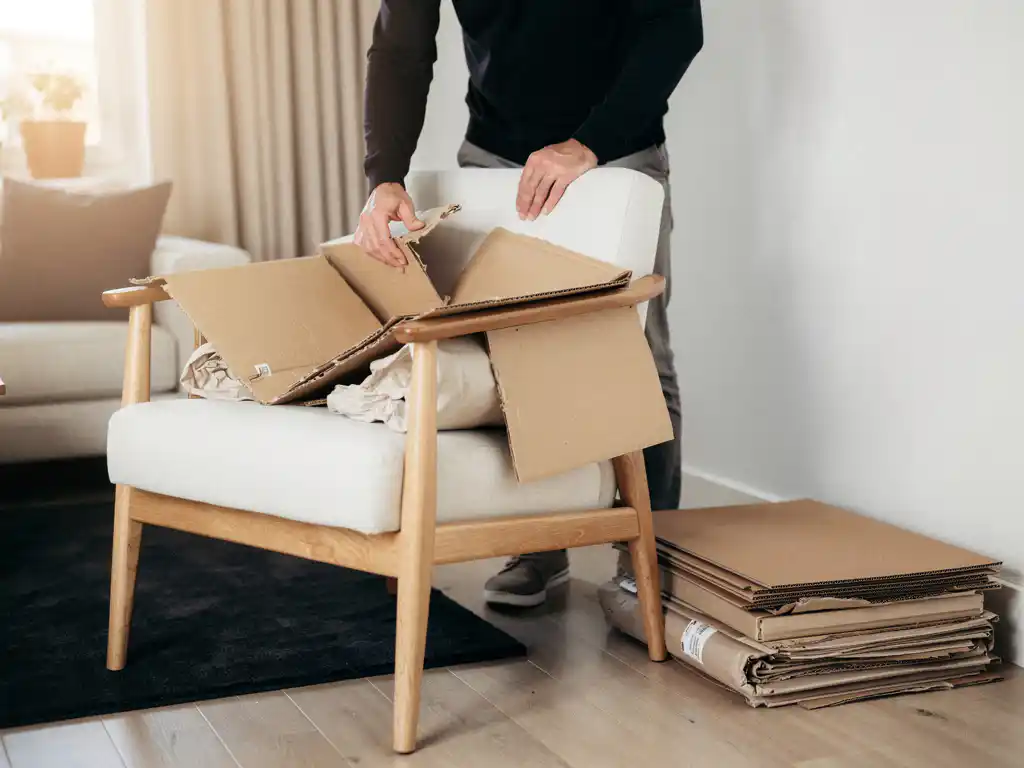
Packaging removal is part of a premium furniture service because it completes the delivery experience. Rather than leaving customers with bulky cardboard, foam, and plastic wrapping to dispose of themselves, a premium service treats removal and disposal as a natural extension of the delivery itself. This distinction separates a basic drop-off from a genuinely white glove furniture delivery, and it matters most to customers who have invested in quality pieces they expect to be treated with care from warehouse to room.
What does packaging removal actually include in furniture delivery?
Packaging removal in a furniture delivery service means the delivery team unpacks each item on-site, removes all protective materials including cardboard boxes, foam inserts, plastic wrapping, and corner guards, and takes everything away with them when they leave. The customer is left with only the furniture, positioned where they want it, with no waste to manage.
In practice, this goes hand in hand with other elements of a full-service delivery. The team typically carries the furniture to the designated room, unpacks it carefully to avoid surface damage, performs any required assembly or installation, and then collects all packaging materials before leaving. For larger pieces such as sofas, wardrobes, or dining tables, the volume of packaging can be considerable, so removal is not a minor convenience but a genuine logistical task.
Some services also include a basic inspection of the item before the packaging is discarded, confirming that no transit damage has occurred while the evidence is still present. This is particularly relevant for high-value or fragile furniture where damage claims need to be supported by documentation at the point of delivery.
Why do premium furniture services include packaging removal?
Premium furniture services include packaging removal because the customer experience does not end when the item arrives at the door. A white glove furniture delivery is defined by its end-to-end care, and leaving behind a pile of waste contradicts that promise. Packaging removal signals that the service is designed around the customer’s convenience, not just the logistics provider’s efficiency.
There is also a practical dimension. Customers who purchase premium furniture are often buying for finished, well-presented spaces such as a newly renovated home, a furnished apartment, or a professional office. These environments are not equipped to handle large volumes of packaging waste, and expecting the customer to manage disposal themselves creates unnecessary friction at the very end of the experience.
From a brand perspective, furniture retailers and manufacturers who offer white glove furniture delivery as part of their proposition understand that the delivery is the last touchpoint before the customer forms their final impression. A smooth, clean handover reinforces confidence in the purchase and increases the likelihood of repeat business and positive referrals.
How does packaging removal differ between residential and project deliveries?
In residential deliveries, packaging removal is typically handled by a small team visiting a single address, removing materials from one or a few items, and taking them away in the delivery vehicle. In project deliveries, the scale changes significantly: multiple items are delivered to a single site, often across several floors or units, and the volume of packaging materials can be substantial enough to require dedicated logistics planning.
Residential packaging removal
For home deliveries, the process is relatively straightforward. The team unpacks items in the room of choice, removes all materials, and loads them back onto the vehicle. The main considerations are access (narrow staircases, lifts, apartment buildings) and timing, since residential customers often expect a precise delivery window and a quick, tidy handover.
Project and commercial packaging removal
For large-scale project deliveries, such as furnishing a hotel, office complex, or residential development, packaging removal becomes a coordinated operation. Hundreds of items may be delivered and installed across multiple locations within a single project. We manage this kind of project logistics by planning waste removal as a distinct workstream, often scheduling collection runs separately from the delivery itself to keep the site clear and the installation team moving efficiently.
What happens to removed furniture packaging after delivery?
After packaging is removed from a furniture delivery, it is transported back to a logistics facility where it is sorted for recycling, compacting, or disposal according to local waste regulations. Responsible logistics providers separate cardboard, foam, and plastic streams to maximise recycling rates and minimise landfill impact.
Cardboard is the most straightforward material to handle since it is widely recyclable and can be compacted efficiently. Foam and polystyrene are more complex because not all recycling facilities accept them, and they take up significant volume. Plastic wrapping and strapping are typically baled and sent to specialist recyclers.
Increasingly, logistics providers are working with furniture manufacturers to reduce packaging at source, using reusable protective materials such as blanket wrapping and transit frames instead of single-use cardboard and foam. This approach reduces the waste stream entirely rather than managing it after the fact, and it aligns with broader sustainability goals across the supply chain.
Should furniture retailers offer packaging removal as a standard or optional service?
Furniture retailers should offer packaging removal as a standard feature of any full-service or white glove delivery tier, not as an optional add-on. When packaging removal is positioned as an extra, it signals that the base service is incomplete, which undermines the premium positioning that justifies the price point in the first place.
That said, there is a reasonable case for a tiered delivery structure where a basic service (kerb-side drop-off or threshold delivery) does not include removal, while a room-of-choice or full installation service always does. The key is clarity: customers should know exactly what is included at each level before they buy, and packaging removal should be explicitly named rather than implied.
Retailers who sell higher-value furniture in particular will find that including packaging removal as standard reduces post-delivery complaints, simplifies the customer journey, and differentiates their offering from competitors who treat delivery as an afterthought. The furniture installation service becomes the complete experience the customer paid for, rather than a handover that leaves them with work to do.
If you are looking for a logistics partner who treats every delivery as a complete service, get in touch with us to discuss how we can support your furniture delivery operation from warehouse to room.