




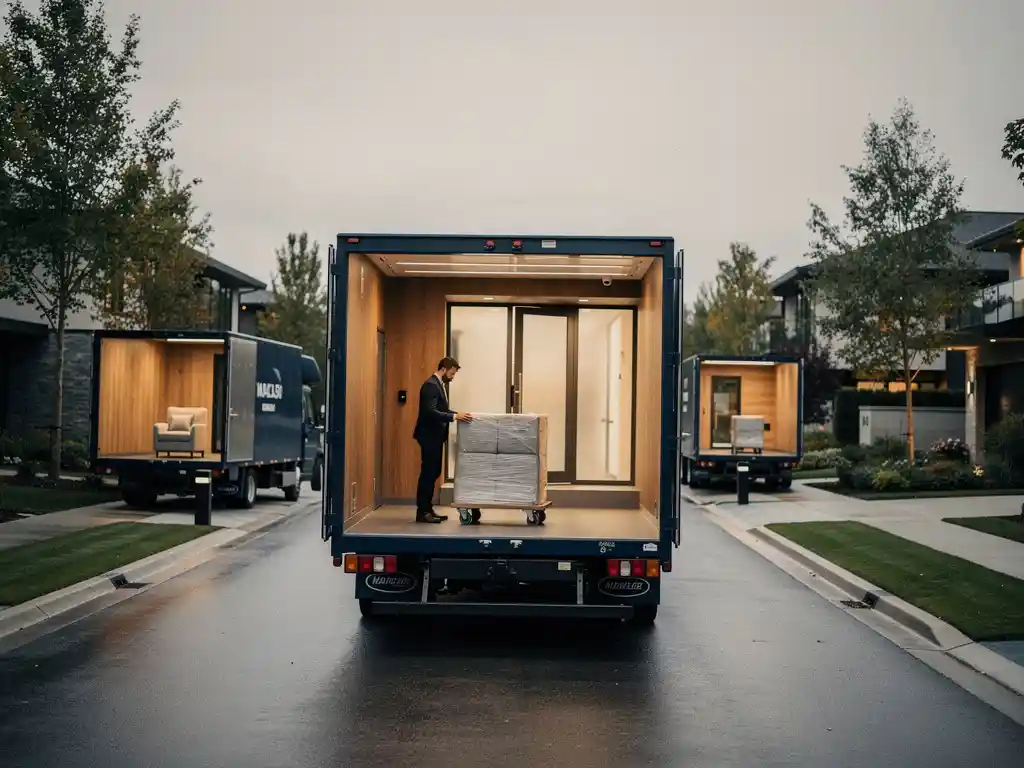
Phased delivery is smarter than delivering everything at once because it aligns the arrival of goods with the actual readiness of a site, reducing the risk of damage, storage pressure, and installation confusion. When materials arrive in stages that match the project timeline, every delivery has a clear purpose and a ready team to receive it. The questions below unpack exactly why staged delivery outperforms bulk delivery across cost, risk, and project fit.
What are the biggest risks of delivering everything at once?
Delivering everything at once creates a serious risk of damage, congestion, and waste. When goods arrive before a site is ready, they must be stored on-site in uncontrolled conditions, handled multiple times, and worked around by other trades. Each additional handling increases the chance of breakage, loss, or delays that ripple through the entire project schedule.
The most common problems with bulk delivery include:
- On-site storage damage: Furniture, fixtures, and equipment stored in unfinished spaces are exposed to dust, moisture, and physical impact from ongoing construction work.
- Traffic congestion: A large delivery floods a site with goods that cannot be placed immediately, blocking access routes for other contractors and trades.
- Installation errors: When everything arrives at once, installation teams face confusion about sequencing, leading to items being placed and then moved again as later stages are completed.
- Accountability gaps: A large, uncoordinated delivery makes it harder to track what has arrived, what is damaged, and what is missing until it is too late to resolve issues cleanly.
For complex projects such as office fit-outs, hotel openings, or school refurbishments, these risks are not theoretical. They translate directly into project overruns and cost increases that could have been avoided with a planned, phased delivery approach.
How does phased delivery reduce costs over a project timeline?
Phased delivery reduces costs by eliminating unnecessary handling, reducing on-site storage needs, and aligning transport with actual demand. Rather than paying for a single large shipment that overwhelms a site, staged deliveries are sized to match what the project can absorb at each point, which keeps logistics lean and efficient throughout.
The cost savings work on several levels. First, warehousing costs are distributed more predictably. Goods can be held in a professional warehouse and released in batches as the site progresses, rather than being stored in expensive or unsuitable on-site conditions. Second, fewer re-handling events mean fewer labour hours spent moving goods that are in the way. Third, damage rates drop, which reduces replacement costs and insurance claims.
There is also a less obvious financial benefit: phased delivery supports better cash flow management for the project. When goods are procured and delivered in stages, capital is not tied up in materials sitting idle on site. For large-scale project delivery logistics, this can make a meaningful difference to overall project finance.
Our warehousing solutions are designed to support exactly this kind of staged release, holding goods securely until the right moment in the project schedule.
Which projects benefit most from a phased delivery schedule?
Projects with multiple phases, tight site access, or sequential installation requirements benefit most from a phased delivery schedule. These are situations where the order in which goods arrive directly affects the quality and efficiency of the work being done.
The strongest candidates for staged delivery include:
- Office and workspace fit-outs: Flooring, partitioning, and IT infrastructure must be installed before furniture arrives. A phased approach ensures each layer is ready before the next is delivered.
- Hotel and hospitality openings: Rooms are typically completed floor by floor, making sequential furniture delivery far more practical than a single bulk shipment.
- Healthcare and educational facilities: These projects often run during operational periods, such as school holidays, where the window for delivery and installation is narrow and precise timing is critical.
- Retail rollouts: When the same fit-out is replicated across multiple locations, phased delivery allows a standardised process to be repeated efficiently at each site.
- Large residential developments: Apartment blocks where units are handed over in batches require furniture and appliance delivery to match the handover schedule rather than the construction completion date.
Our project logistics service is built around exactly these kinds of complex, multi-phase environments, operating across more than 150 locations worldwide.
How does phased delivery work in practice?
In practice, phased delivery works by mapping the project schedule, identifying key milestones, and assigning delivery windows to each stage. This requires close coordination between the logistics provider, the project manager, and the installation teams so that every delivery arrives when the site is genuinely ready to receive it.
The process typically follows these steps:
- Project mapping: The logistics team reviews floor plans, construction schedules, and installation sequences to understand what is needed and when.
- Delivery window planning: Based on the project map, specific delivery dates and time slots are assigned to each batch of goods.
- Warehousing and batch preparation: All goods are received into a warehouse, quality checked, and organised into delivery batches ready for dispatch at the right moment.
- Coordinated on-site delivery: Each delivery arrives with the right team, the right equipment, and clear instructions for placement or installation, minimising time on site.
- Real-time communication: Any changes to the project schedule are communicated quickly so delivery windows can be adjusted without disrupting the overall plan.
This level of coordination is what separates a well-executed staged delivery from a loosely split shipment. The planning that happens before the first vehicle leaves is what makes the difference on the day.
What’s the difference between phased delivery and just-in-time delivery?
The key distinction is that phased delivery is planned around project milestones, while just-in-time delivery is driven by production or consumption triggers. Phased delivery works in batches tied to construction or installation stages, whereas just-in-time delivery aims to minimise inventory by delivering goods at the precise moment they are needed for a process.
Just-in-time is most commonly associated with manufacturing, where components arrive continuously to feed a production line with minimal buffer stock. It depends on highly predictable, repeatable demand and a very reliable supply chain. When either of those conditions is absent, just-in-time becomes fragile.
Phased delivery for logistics delivery planning in construction or fit-out projects is more forgiving. It builds in practical buffers between stages, acknowledges that construction timelines shift, and prioritises coordination over pure inventory minimisation. The goal is not to eliminate all stock at the point of use, but to ensure the right goods are available at the right stage of a project without overwhelming the site or the team.
For most furniture, kitchen, and project installation scenarios, phased delivery is the more appropriate model. Just-in-time works well when conditions are controlled and predictable; phased delivery works well when projects are complex and dynamic.
When should you start planning a phased delivery schedule?
Planning for phased delivery should begin as early as the project design phase, ideally before procurement starts. The later planning begins, the fewer options are available for sequencing deliveries intelligently, and the more likely it is that goods will arrive out of order or ahead of site readiness.
Early planning enables several important advantages. Procurement can be timed so that goods are manufactured or sourced in the right sequence, not all at once. Warehousing can be arranged in advance so there is a reliable holding facility for goods that are ready before the site is. And the logistics provider has enough lead time to coordinate transport, installation crews, and site access in a way that is efficient rather than reactive.
A practical rule is to involve your logistics partner at the same time you involve your main contractor. If the construction schedule is being built, the delivery schedule should be built alongside it. Changes to one will almost always affect the other, and having both parties aligned from the start prevents the kind of last-minute scrambling that drives up costs and stress.
If you are planning a complex project and want to understand how phased delivery can be structured around your specific timeline, get in touch with our team to discuss your requirements.